Reading list, by learner level

Blue energy resources for India

A long-form reading list for anyone interested in ocean energy in India — from a class-9 student doing a school project to a doctoral candidate modelling landfall feasibility. Each item on this page is a primary source better read directly than summarised. Where a resource has variant versions (a press release, a working paper and a peer-reviewed paper), the peer-reviewed entry is preferred as the canonical citation.

Atlases Working papers Peer-reviewed journals Government reports OpenCourseWare News
How to read every ocean energy number on this site. Every statistic — the 9.2 lakh TWh headline, every per-form estimate, every pilot-plant capacity — is presented at four levels: resource potential (gross energy physically present in a sea cell), extractable potential (what a real device can capture at realistic efficiency), techno-economic potential (what is plausibly deployable at plausible cost with grid access) and project feasibility (what survives site-specific engineering, environmental and social screening). The largest number is always the resource potential. For any deployment-relevant figure, look at the techno-economic line. The reading list below is mapped against that ladder: atlases cover the resource rung, working papers the techno-economic rung, project reports the feasibility rung.

How to use this list

Most readers of a topic on an Indian-language site have already read several news pieces, at least one Wikipedia entry, perhaps a Hindustan Times or Indian Express coverage. The list below is what to read after those — not the same material at higher fidelity, but new material with citations. The list is also deliberately Indian-first: international reading lists are easily searched. The harder question is what an Indian reader can find that is anchored to Indian data, Indian instruments and Indian pilots.
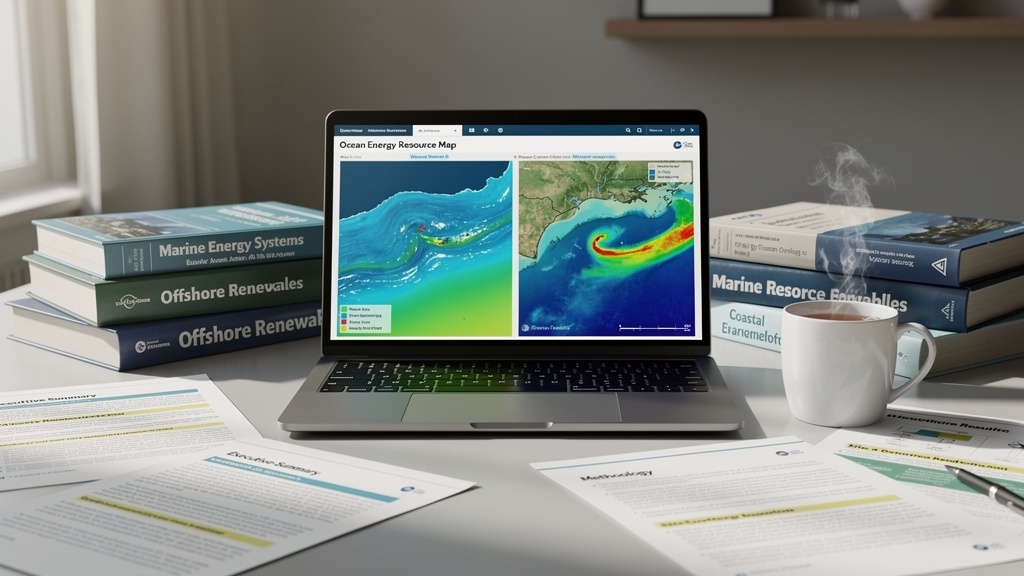

A clean wooden desk with an open laptop showing a research paper, a printed INCOIS report and a fountain pen, suggesting a focused research session.
Primary literature — the desk-anchor for nailing down a number, not inferring it.
An open textbook on ocean energy held by a young researcher near a window with daylight, suggesting deep reading.
Reading deeply — many of the items below are 200+ page working papers. Read them once carefully.
A small Indian classroom setting with students watching a presentation on marine renewables, a laptop showing a wave-energy diagram.
Classroom introductions — the resources list also serves learners at the entry level.
Atlases & resource datasets

The resource-rung database

The first rung of the reading ladder: maps and datasets that describe the physical energy in India’s sea cells.

1. INCOIS Integrated Ocean Energy Atlas

The headline reference for the 9.2 lakh TWh figure cited across this site. The atlas aggregates wave, tidal, OTEC, salinity, offshore wind and ocean-current resource data over the Indian EEZ. INCOIS publishes versions of this atlas periodically; the version used as a citation should be the most recent one with a stated methodology section.

Where to find it: incois.gov.in — site search for “Integrated Ocean Energy Atlas”.

2. NIOT Technical Reports (LTTD and OTEC)

NIOT publishes technical reports on Lakshadweep LTTD plants, OTEC closed-cycle ammonia test rigs, deep-sea vehicle class work, and the SUVIDHA desalination pilot. Each report has a working-figure appendix with operating data, downtime data and capex figures.

Where to find it: niot.res.in → publications → technical reports.

3. INCOIS Operational Ocean Forecasts

The live ocean-forecast products at INCOIS cover wave height, tidal height, sea-surface temperature, salinity and current. These are the short-horizon data inputs for any feasibility study; they are also the public data for a school project or a doctoral site-screening exercise.

Where to find it: incois.gov.in/portal/forecast.

4. Indian Tidal Atlas (Survey of India)

The Survey of India publishes tidal atlases for the Indian coast covering the Gulf of Kutch, the Gulf of Khambhat and the Sundarbans. Tidal-amplitude and phase data are the primary inputs to a tidal-stream feasibility study, and they pre-date any marine-energy atlas by decades.

Where to find it: surveyofindia.gov.in.

Government reports and policy documents

The official-cite layer

The middle rung. These documents are what show up in MNRE submissions, in INCOIS technical reports and in SECI policy briefs. They are dense and rarely pretty, but they are the documents that specify the policy and instruments actually deployed.

5. Draft Blue Economy Policy 2021

India’s MoES-led Draft Blue Economy Policy, published for stakeholder comments in 2021. The draft unifies seven pillars — fisheries, ports and shipping, marine biotech, marine biology, coastal tourism, deep-sea minerals and ocean energy — under a single blue-economy frame.

Where to find it: moes.gov.in → schemes and programmes.

6. National Offshore Wind Energy Policy 2015 (draft)

India’s framework document for offshore wind: the lead ministry, the FDI setting, the lease-block procedure, the security clearance overlay. The 2015 draft has been supplemented by ministerial notifications and VGF windows, but remains the working policy document.

Where to find it: mnre.gov.in.

7. Deep Ocean Mission Cabinet Note

The MoES cabinet note for the Deep Ocean Mission, which lays out the six sub-missions including the fifth — ocean-energy-and-desalination. The note is the highest-level policy document relevant to OTEC, LTTD and ocean-energy R&D under MoES.

Where to find it: moes.gov.in → Deep Ocean Mission sub-page.

8. MNRE-WISE Working Papers

MNRE-WISE — the Working Group on Innovation, Science and Economy associated with the Ministry — publishes a stream of working papers on renewable energy, including blue energy. These are the canonical Indian sources for cost-tracking and policy discussion at the techno-economic rung.

Where to find it: mnre.gov.in → Knowledge Resources → Reports.

Working papers and techno-economic literature

The techno-economic-rung reading

These are the working papers and reports that anchor the LCOE and feasibility numbers used across this site. They are also the sources that translate from raw resource maps to deployable capacity.

9. IEA-OES Annual Reports

The International Energy Agency’s Ocean Energy Systems (IEA-OES) annual report tracks technology readiness levels, installed capacity, project finance and policy context across more than 25 member states. India is a member. The annual reports are the working-paper anchor for international benchmarking of wave, tidal, OTEC and ocean-current technologies.

Where to find it: iea-oceans.org.

10. IRENA Renewable Power Generation Costs

IRENA publishes an annual series on the cost of power generation across renewables. Even though marine volumes are still modest in IRENA’s coverage, the cost-tracking methodology can be applied to marine LCOE; combined with SECI tender outcomes, IRENA’s series gives a cross-checked Indian and global cost path.

Where to find it: irena.org → Costs.

11. World Bank Blue Economy Flagships

The World Bank publishes a sea-country blue-economy series — Indian Ocean, Senegal, Mozambique — that includes India as a case study. The series frames blue economy in marine-spatial-planning and inclusive-growth terms; the World Bank’s methodology is the most widely-referenced framework for inclusive blue-economy accounting.

Where to find it: worldbank.org → Blue Economy.

12. SECI Tender Outcome Reports

SECI publishes outcome reports for each solar, wind and offshore-wind reverse-auction round. The reports cover tariff discoveries, project timing milestones, VGF application patterns and PA-DC-utility pairing. They are the working-data anchor for the offshore-wind tariff trajectory.

Where to find it: seci.co.in.

Academic journals

Peer-reviewed corpus, by topic

The peer-reviewed corpus on marine renewables is substantial internationally; the specifically Indian body of work is smaller but growing. The list below picks representative journals by topic.

Renewable Energy (Elsevier)

The most-cited peer-reviewed journal covering individual renewable-energy classes and country studies. Indian blue-energy contributions appear here regularly, particularly OTEC-LTTD at Lakshadweep, salinity-gradient at IIT Madras, and floating PV pilots at Omkareshwar.

Journal of Marine Science and Engineering (MDPI)

Open-access peer-reviewed journal covering offshore-wind feasibility, wave-energy converter design, seabed-rights legal questions and ocean-energy economics. Indian authorship is high.

Energy Policy (Elsevier)

Policy-focused; relevant for the policy-and-institutions summary on the resource side. Several Indian Renewable Energy Ministry working papers get republished here in condensed form.

Applied Ocean Research (Elsevier)

The offshore-engineering flagship. Loads on Indian wave-energy buoy design and offshore-wind foundation engineering; INCOIS and IIT-Madras authors publish here.

Deep-Sea Research Part I (Elsevier)

Deep-oceanography flagship. Relevant for OTEC deep-water-pipe design, deep-sea-mineral exploration, and the cold-water-pipe engineering bottleneck.

Ocean Engineering (Elsevier)

Operational engineering of marine systems, including offshore-wind and tidal-stream foundations. Indian authorship is strong.

Indian faculty and labs

Who to follow

Most blue-energy R&D in India sits at a small number of institutions. Putting names to institutions is the next step after reading the literature.

IIT Madras — Ocean Engineering group

Wave-energy buoy prototypes, salinity-gradient pilots, OTEC closed-cycle rig collaboration, and floating PV follow-on work. Faculty pages at the Ocean Engineering department list publications.

Where to find it: iitm.ac.in → Departments → Ocean Engineering.

NIOT — Chennai

India’s national ocean-technology institute. LTTD plants, OTEC cold-water pipe work, SUVIDHA pilot, Babel-class work on marine-grade electronics. Publications at NIOT are dense and at high technical specificity.

Where to find it: niot.res.in → Publications.

IIT Bombay — Energy Sciences and Floppy-disc group

Tidal-stream research, wave-energy buoy work, infrastructure for offshore-wind hub analysis. Faculty and student publications index at IIT Bombay.

Where to find it: iitb.ac.in → Departments → Energy Science and Engineering.

The Energy and Resources Institute (TERI)

Policy-and-economics work on renewable energy in India. Several blue-economy TERI working papers are the most-cited Indian policy-source documents for renewable-and-blue-economy overlap.

Where to find it: teriin.org.

OpenCourseWare and online courses

For Indian learners, structured

Online courses are most useful to learners who do not yet have a deep physical-science vocabulary. The list below covers English-language and Indian-context options; English language is significant for Indian learners not yet comfortable with Hindi or another regional-language alternative.

MIT OpenCourseWare — Marine Energy

MIT’s opencourseware offerings cover ocean engineering, offshore wind and marine hydrodynamics. The course “2.00 Toying with Engineering” and “2.019 Design of Ocean Systems” are the most widely-cited entry points.

Where to find it: ocw.mit.edu → search for ocean energy.

UNESCO Marine Energy Open Resources

The UNESCO Marine Energy curriculum resource, developed jointly with the IEA-OES collaboration, is the most policy-aligned courseware offering. It is targeted at upper-undergraduate and postgraduate curricula.

Where to find it: unesdoc.unesco.org.

Wave Energy Centre at the University of Edinburgh

The University of Edinburgh’s wave-energy centre, in association with EMEC, offers tiered online courses — introductory, technical, advanced — on ocean-wave energy and tidal-stream.

Where to find it: wave-energycentre.org.

NPTEL — Indian national platform

NPTEL offers Indian-context courses on renewable energy, ocean engineering and tidal energy. Lectures are in English, with several faculty from IIT Madras and IIT Bombay. The IIT-Madras OE-class course on offshore structures and waves is the most relevant.

Where to find it: nptel.ac.in.

For school students

Class 8 to class 12 reading and project material

For Indian students close to choosing their field. The list below is short, accessible, and uses Indian-context examples.

INCOIS explainers and posters

INCOIS publishes posters and short explainer videos on ocean phenomena, suitable for class 8–11 project work. They are downloadable, well-illustrated, and have low technical density.

Where to find it: incois.gov.in.

TIFR’s Vigyan Pratibha outreach

Vigyan Pratibha, a TIFR-led science outreach programme, has curated reading lists and quiz books on weather, climate and ocean science for class 9–12 learners.

Where to find it: vigyanpratibha.in.

NCERT Oceanography chapter (Geography class 11)

The NCERT Geography textbook for class 11 has a chapter on oceanography that introduces wave, tidal and marine-energy concepts at the secondary level. The text is aligned with the school syllabus and freely downloadable.

Where to find it: ncert.nic.in.

CSIR-NIScPR “Science Reporter” blue economy issue

The Council of Scientific and Industrial Research’s popular-science periodical “Science Reporter” has featured blue energy issues in recent years. The articles are accessible but technically accurate, and well-suited for project reports.

Where to find it: niscpr.res.in.

News and policy commentary

For the working professional

For readers who want to be cued into new developments without reading every primary paper.

Mongabay India

Long-form journalism on Indian ocean policy, coastal communities and the marine environment. Useful for monitoring the public-policy conversation on the coastal-zone side.

Hindustan Times / The Hindu Business Line

Indian business dailies track offshore wind tenders, FPV pilots, Lakshadweep LTTD operating data, and SECI tariff outcomes. They are the most reliable newsfeed for Indian renewable-energy working professionals.

Reuters / Bloomberg

International wires for tender outcomes and global marine-renewable industry news; useful for international coverage that Indian papers miss.

Down to Earth magazine

Indian environmental science magazine with a long-running coastal and marine beat. Useful for ecosystem-and-habitat discussions.

Mercom India

The most-focused Indian trade publication on renewable energy tenders, project finance and corporate deals. Useful for tracking offshore-wind and FPV deal flow.

Rethink Energy / Recharge (industry)

Industry publications tracking global wind and ocean-energy capital flows. Useful for international benchmarking of Indian projects.

Databases

Machine-readable datasets

For readers writing code or running analysis.

INCOIS API

INCOIS exposes live ocean forecasts over an API for admissible users. The API extends to wave height at 0.5° resolution over the Indian EEZ, sea-surface temperature at 0.05° resolution, and tidal constituents at coastal stations.

Where to find it: incois.gov.in/portal/api.

OpenStreetMap marine layers

OpenStreetMap has marine polygons usable for coastal-state consenting and EIA work. The OSM marine layer continues to be enriched; its present coverage of the Indian EEZ is workable for general mapping but is thin compared to the European coast.

Where to find it: openstreetmap.org.

Global Wind Atlas

The Global Wind Atlas provides offshore wind resource data at decent spatial resolution, both inside the Indian EEZ and globally. It is one of the easiest first-pass datasets for site-feasibility analysis.

Where to find it: globalwindatlas.info.

NASA MODIS sea-surface temperature

MODIS-derived sea-surface temperature at 4 km resolution is enough to size the OTEC thermal gradient for tropical-island sites. It is freely available through NASA’s ocean colour portal.

Where to find it: oceancolor.gsfc.nasa.gov.

Frequently asked

Reading-list questions, answered

What is the single-best starting reference for an Indian reader new to marine renewables?

For a non-specialist Indian reader, the INCOIS Integrated Ocean Energy Atlas is the canonical entry, supported by the IEA-OES annual report as the international reference, and an NCERT class-11 chapter for the conceptual level. Read these three for a working grasp; from there, set the IEA-OES annual as the regular tracking publication.

Where can I download the INCOIS atlas?

INCOIS publishes the atlas through its website at incois.gov.in. Some versions are downloadable as PDFs; data layers are exposed through the API. Earlier versions of the atlas may have been published in the form of maps; the most recent published edition of the Integrated atlas is the recommended starting point.

How do I get the LCOE numbers used by MNRE?

Two routes. First, the MNRE-WISE working papers, published at mnre.gov.in, give official indicative LCOE bands. Second, the SECI tender outcome reports at seci.co.in give discovered-tariff figures for actual tender rounds. The two together provide a working cross-check; SECI alone is the more conservative and authoritative number because it reflects real money.

Which Indian journal publishes the most blue-energy papers?

There is no Indian-only journal that is the canonical blue-energy venue; most Indian blue-energy papers appear in international peer-reviewed journals — Renewable Energy, Applied Ocean Research, Ocean Engineering — with significant academic authorship from IIT Madras, IIT Bombay, IIT Delhi, Anna University and NIOT. The Indian Journal of Marine Sciences has begun carrying blue-economy themes as well.

Where does the school student find an introductory primer?

The NCERT class-11 Geography textbook’s Oceanography chapter is the canonical school-level primer, supplemented by the CSIR-NIScPR Science Reporter magazine and the INCOIS explainer posters. The Vigyan Pratibha TIFR project offers supplementary reading and curriculum aids.

What is the best English-language reading on Indian offshore wind?

The 2015 Draft National Offshore Wind Energy Policy is the framework-level entry, supplemented by MNRE-WISE working papers and SECI tender outcome reports. For industry-side reporting, Mercom India is the most-cited Indian trade outlet, with Reuters and Bloomberg providing international coverage.

Are there audio/visual resources suitable for Indian learners who are not reading-comfortable in English?

Yes. The Earth Sciences MoES YouTube channel carries short Hindi and English videos on ocean-energy instruments and pilot operations. INCOIS produces short-format videos on Tsunami-early-warning and ocean-state forecasting which is adjacent to the marine renewables conversation. The MoES Deep Ocean Mission social-feed posts short-format video content.

Read, then come back to the data

Reading primary literature outside this site sharpens the questions to ask of Indian blue-energy policy. Use the reading list above as a secondary partner to the resource data on this site and the policy decisions covered on the Policy and Institutions page.