Governance & instruments

Blue energy: policy & institutions in India

India’s blue-energy policy does not sit in one ministry or under one act. The resource is mapped by INCOIS, the technology is researched at NIOT and the IITs, the lead ministry for renewables is MNRE, the lease regime for offshore energy sits with the Ministry of External Affairs (defence clearance) and the Ministry of New and Renewable Energy (allocation), tenders are run by SECI, and the wider blue-economy umbrella sits under the Ministry of Earth Sciences. This page lays out who decides what and which policy instruments actually shape deployment today.

MNRE Ministry of Earth Sciences NIOT INCOIS SECI Deep Ocean Mission CRZ regime Offshore wind framework
How to read every ocean energy number on this site. Every statistic — the 9.2 lakh TWh headline, every per-form estimate, every pilot-plant capacity — is presented at four levels: resource potential (gross energy physically present in a sea cell), extractable potential (what a real device can capture at realistic efficiency), techno-economic potential (what is plausibly deployable at plausible cost with grid access) and project feasibility (what survives site-specific engineering, environmental and social screening). The largest number is always the resource potential. For any deployment-relevant figure, look at the techno-economic line. The policy instruments cited below are sized to move the techno-economic and project-feasibility rungs, not the resource line.

Why the policy picture is several ministries wide

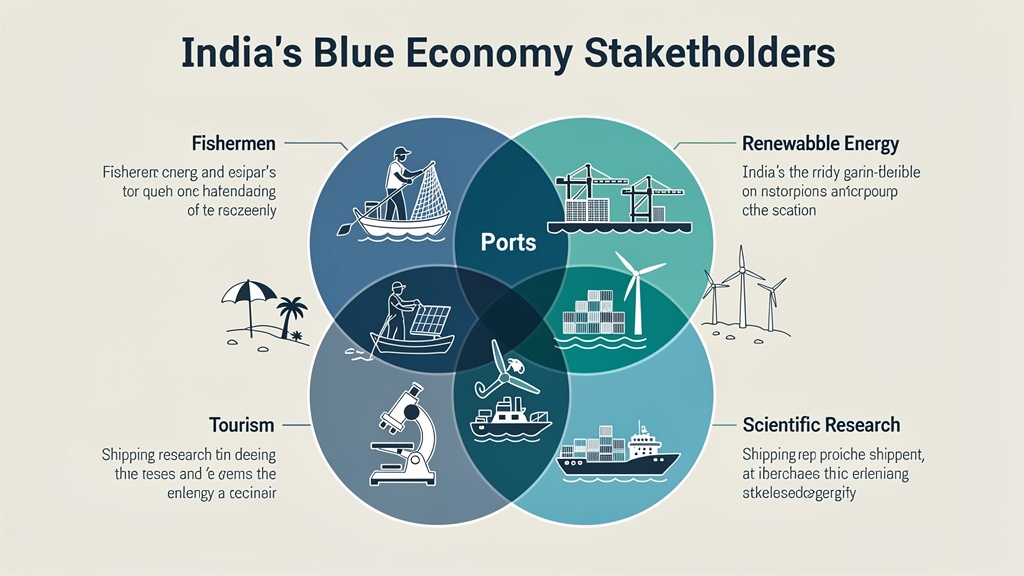
Marine energy sits at the intersection of energy policy (target-setting, tendering, evacuation regimes), earth-sciences policy (resource measurement, ocean observation), fisheries and coastal-regulatory policy (CRZ and EIA), defence and shipping policy (submarine clearance, navigation corridors) and industry policy (manufacturing-linked incentive). No single Indian ministry owns the full stack. That is the reason for several coordinated instruments rather than one blue-energy act.

The entrance facade of a major Indian public-sector research institution in a clean modernist style, evoking NIOT or INCOIS.
Public-sector research — NIOT, INCOIS and the IITs carry most of the country’s blue-energy R&D.
A round-table meeting of senior officials and developers in an Indian government conference room, with charts showing tender outcomes.
Stakeholder roundtables — most Indian blue-energy decisions are taken after multi-ministry consultation.
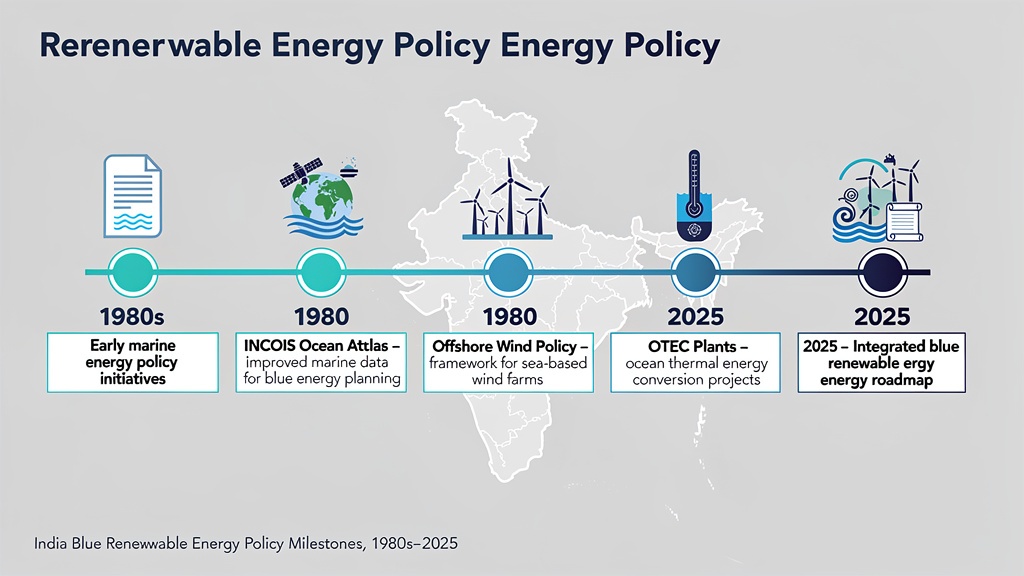
A long printed Indian policy timeline poster tracking the major milestones of offshore-wind lease blocks and the Deep Ocean Mission.
Policy timeline — blue-energy instruments have rolled out in distinct waves, not as a single act.
The ministries and their roles

Who does what

Seven ministries and four umbrella schemes shape India’s blue-energy decisions. None of them acts alone; they coordinate, sometimes sequentially and sometimes in parallel.

Body Role in blue energy Anchor instruments
Ministry of New and Renewable Energy (MNRE) Lead ministry for renewable deployment: target-setting, Viability Gap Funding, offshore-wind lease blocks, FPV pilots dashboard. National Offshore Wind Energy Policy, 2015 (drafted, under revision 2024); Viability Gap Funding window 2024–2029.
Ministry of Earth Sciences (MoES) Umbrella ministry for ocean observation, climate services, and the Deep Ocean Mission, which includes the ocean-energy sub-mission. Deep Ocean Mission, launched 2021; ocean-energy sub-mission under SAMRIDH and DOM programmes.
National Institute of Ocean Technology (NIOT) The Chennai-headquartered technology arm under MoES. Designs and pilots LTTD, OTEC cold-water pipe segments, underwater turbines, wave-energy buoyancy modules. LTTD plants at Kavaratti / Agatti / Minicoy; OTEC test rigs at Chennai; SUVIDHA desalination-cum-power pilot.
Indian National Centre for Ocean Information Services (INCOIS) Resource assessment. Maintains the Integrated Ocean Energy Atlas (9.2 lakh TWh headline). Issues operational ocean forecasts used for project feasibility checks. Integrated Ocean Energy Atlas; live Indian Ocean wave, tidal and SST forecast products.
Solar Energy Corporation of India (SECI) Central public-sector tendering agency. Runs offshore wind reverse auctions; tendered the first 4 GW of Gujarat and Tamil Nadu offshore wind. SECI offshore wind reverse-auction rounds, 2022–2024.
Ministry of Environment, Forest and Climate Change (MoEFCC) EIA Notification 2006 and CRZ Notification 2019. Site-level environmental clearance for ports, plants, transmission corridors, and offshore lease blocks. EIA Notification 2006 (and 2020 amendment); CRZ Notification 2019; Wetlands Rules 2017.
Ministry of External Affairs (MEA) / Ministry of Defence (MoD) Defence clearance for offshore energy installations; foreign-investment clearance for offshore-wind subsea-cable terminal and interconnector projects. Defence-consultation procedure; FDI clearance for offshore wind FDI up to 100% under automatic route.
Ministry of Ports, Shipping and Waterways (MoPSW) Navigation corridor overlays; safety buffer around shipping lanes and territorial waters; consent for submarine cable landings. Major Ports Authorities Act 2021; Indian Ports Act (amended provisions).
State Maritime Boards / Coastal State Governments Site-level consent, landfall consent, seabed-rights overlay in territorial waters (12 nautical miles). State Maritime Boards (constituted across coastal states); coastal-state Maritime and Fisheries policy.
Offshore wind policy

How the offshore-wind framework evolved

Of all blue-energy sub-policies in India, offshore wind has the clearest documentary trail, because it has gone through the most rounds of lease allocation, tender design, and policy amendment. The story below traces the framework from the first policy to the current tendering regime.

2015

National Offshore Wind Energy Policy, draft

The 2015 draft framework set the structure for offshore-wind block allocation, the 0%–100% FDI band, and the role of MNRE and SECI. It defined an offshore wind project boundary and a framework for transmission evacuation. The 2015 policy has remained the working document, with subsequent task-force recommendations rather than a full revision.

2016–2018

Resource mapping, lease block identification

Initial lease blocks identified off Gujarat coast (Pipavav, Gujarat Gulf) and southern Tamil Nadu. INCOIS-led wind-resource campaign; seismic and geophysical surveys for foundation design.

2019–2021

Site allocation, pre-feasibility

Alungu lease block (Tamil Nadu) and Pipavav cluster allocated for site feasibility. MoU model with state distribution utilities for power off-take framework. Initial interconnection studies.

2022

SECI reverse-auction rounds, first reverse auction round

SECI ran the first round of reverse-auction tendering for offshore wind. The round reflected firm allocation of 4 GW across blocks near Gujarat and southern Tamil Nadu.

2023

Viability Gap Funding window opens

MNRE notified a Viability Gap Funding (VGF) window under the Union Budget to underwrite the cost gap between offshore wind LCOE and the average power purchase cost (APPC) of distribution utilities.

2024

Hybrid and floating wind pilots progress

Floating-wind pilots added to the policy dialogue through consultations with MNRE, NIWE and SECI. Framework for floating-wind acreage under negotiation; FPV pilots on inland reservoirs expanded.

The Deep Ocean Mission

The MoES umbrella for ocean technology

The Deep Ocean Mission (DOM) is the Ministry of Earth Sciences’ flagship within blue-economy policy. It has six sub-missions, one of which is directly relevant to blue energy as defined on this site.

DOM sub-missions, one by one

  1. Deep-sea biodiversity exploration: biodiversity survey of the deep-water column, including the 6,000 m depth range.
  2. Deep-sea mineral exploration: resource survey of polymetallic nodules and gas hydrates.
  3. Ocean climate and advisory services: ocean-observation network, climate forecasting, advisories for fishing and shipping.
  4. Underwater vehicles and technology: deep-sea submersibles, ROVs and autonomous platforms.
  5. Ocean energy and desalination sub-mission: OTEC cold-water pipe demo, LTTD scaling, blue-energy resource assessment.
  6. Advanced marine biology and biodiversity research: marine biology and pharmacology research.

The blue-energy windfall under DOM

The fifth sub-mission explicitly covers blue energy as defined here. It has funded the modernisation of OTEC cold-water pipe fabrication, the work on ammonia-based closed-cycle OTEC at NIOT Chennai, the OS-EWAC wave-energy prototype pilots, and the salinity-gradient pilot at IIT Madras. The mission provides five-year funding windows through 2026–2031, which is the relevant horizon for serial-fabrication cost decline.

DOM is not a subsidy instrument — it is an R&D-and-demonstration instrument. That distinction matters: it lowers the cost of de-risking each new device, but it does not by itself guarantee commercial serial production.

State and local authorities

The missing layer: how projects get across the finish line

Even after central policy and central tendering is complete, every coastal project still requires local consents. The most binding local layer — and the most variable — is the state.

Coastal State Governments

Each coastal state — Gujarat, Maharashtra, Goa, Karnataka, Kerala, Tamil Nadu, Andhra Pradesh, Odisha, West Bengal — has its own CRZ planning authority, its own Maritime Board (in most cases) and its own distribution licensee. Project-level consenting sits in the agreement between the central developer, the central tendering agency and the state.

Coast Guard and Navy

Submarine-cable landing and offshore platforms intersect with defence security zones. The Indian Coast Guard and the Navy are consulted on each lease block. The consultation typically resolves well, but adds months to the consenting timeline.

Fishing panchayats and customary marine tenure

Small-scale fishing communities hold customary use rights in tidal and estuarine waters. They are coordinated through Gram Panchayat, Coastal Aquaculture Authority and state fisheries machinery. Their informed consent is the binding social licence instrument for marine renewables.

Tendering and VGF

How tendering and gap-funding close the cost gap

The blue-energy LCOE bands discussed on the Benefits & Challenges page are still above the average power-purchase cost in India. Two instruments exist to close that gap: reverse auctions through SECI, and Viability Gap Funding (VGF) notified by MNRE.

Reverse auction: the SECI mechanism

Standard SECI practice in renewables is the reverse auction — developers bid down per kWh tariffs in competition for blocks of pre-allocated capacity. The reverse-auction mechanism has driven down PV and onshore-wind tariffs substantially since 2015. The mechanism has been extended to offshore wind. The first round of offshore-wind tendering in 2022 produced tariff discoveries that were viable only with VGF overlay, reflecting the LCOE gap above.

Viability Gap Funding: the underwrite

VGF is a capital subsidy underwritten by the central government. Under the offshore-wind VGF window operating since 2023, the centre underwrites a fixed ₹ per MW figure, payable at financial closure and against milestones. VGF is not a tariff subsidy — it does not pay for every kWh; it lowers the initial capital cushion the developer must recover before the project becomes self-sustaining.

Why VGF matters. For an Indian blue-energy project, the binding constraint is rarely the LCOE arithmetic alone; it is whether the project can secure project-finance debt at a reasonable cost. VGF reduces the equity cushion; lower equity cushion means larger debt tolerance; larger debt tolerance means cheaper debt. The cascade closes the LCOE gap indirectly through balance-sheet mechanics rather than through operating revenue alone.
International context

Where India sits in the global marine renewable energy dialogue

Blue energy is not an exclusively Indian conversation. International cooperation shapes technology transfer, financing terms, and standard-setting, especially for serial fabrication.

IEA Ocean Energy Systems (OES)

India is a member of the IEA-OES collaboration, which tracks technology readiness levels, cost trajectories, and project performance across more than 25 member states. The collaboration publishes annual reports that the MNRE and SECI also draw on for tariff-setting windows.

Mission Innovation and IRENA

India participates in Mission Innovation’s ocean-energy challenge and is a member of the International Renewable Energy Agency (IRENA). Through IRENA’s cost-tracking and policy work, India’s MNRE benchmarks its gap-funding windows and tender designs against global practice.

Bilateral and multilateral R&D partnerships

NIOT and the IITs are partners with the European Marine Energy Centre (EMEC), Ocean Energy Europe and several Japanese ocean-energy consortia. Wave-energy test-tank benchmarking, FPV operation in tropical waters, and OTEC closed-cycle ammonia partnerships sit in this stream.

South Asian regional cooperation

SAARC-level cooperation is thinner than bilateral cooperation. Sri Lanka’s coast shares wave and tidal regimes with Tamil Nadu; the Maldives’ island-diesel-to-LTTD-share transition is the closest Indian-architecture precedent for Indian Lakshadweep.

Policy gaps

Three still-open questions for Indian policy

The framework above works for offshore wind and for the small OTEC/LTTD pipeline. It is not yet fully developed for the other blue-energy forms, and the binding constraints are policy-level rather than engineering-level.

1. A unified lease regime

Offshore wind has a lease regime. Wave, tidal, OTEC, salinity gradient and ocean-current projects do not all have one. Each falls through a different combination of central-state-local consent. A unified seabed lease regime would materially shorten project timelines.

2. Marine energy tender under SECI

SECI’s tendering competence is mature for solar and onshore wind; for offshore wind it has just begun. Marine-energy-specific tender lots with capex-friendly risk-sharing instruments would help reduce developer hesitation at tenders under ₹6/kWh APC.

3. Island energy-and-water tariff

Lakshadweep, Andaman and Nicobar, and Minicoy-class islands do not have a single tariff framework that recognises both electricity and desalinated water as co-products of OTEC-LTTD plants. The current framework prices electricity as electricity and subsidises water separately. A combined tariff, or a single off-taker for both, would materially improve project economics.

Frequently asked

Questions on policy, answered

Which ministry is the single point of contact for a blue-energy project in India?

For offshore wind, it is MNRE (with SECI as the central tenderer). For OTEC and LTTD, it is MoES (through NIOT). For floating PV on inland reservoirs, it is again MNRE (with state DISCOM tenders possible). There is no single-point-of-contact for marine renewables as a whole, and unifying this is one of the policy reforms being discussed at the consultative level.

Does India have a national target for ocean energy?

India has a 500 GW non-fossil capacity target by 2030 and a 2070 net-zero target; marine energy as a distinct sub-target has not been notified. The 175 GW renewable target set for 2022 was categorised across solar, wind, biomass, hydro and small hydro; marine was not separately enumerated. Targets for offshore wind have been bundled within the larger renewable target, with a separate working figure of 30 GW offshore wind by 2030.

What does the 2015 National Offshore Wind Energy Policy actually do?

It defines offshore wind as a separate renewable class; it sets MNRE as the lead ministry and SECI as the central tenderer; it allows 100% FDI under the automatic route; it sets the procedural framework for site identification, security clearance, environmental clearance and grid evacuation. The framework has been supplemented by ministerial notifications and VGF windows since 2022, but it has not yet been replaced by a new consolidated policy.

How is fishing-panchayat consent reflected in policy?

The EIA Notification 2006 and the CRZ Notification 2019 require local consultation including affected fisheries; the Coastal Aquaculture Authority is a parallel consent layer for aquaculture components of OTEC-LTTD projects. The binding instrument is not statutory alone — it is the requirement that the panchayat receive project information in a form they can use. Implementation strength varies sharply across states.

Is the Deep Ocean Mission adequately funded?

DOM is funded for R&D and demonstration. Its ₹~4,000 crore envelope over five years is sufficient to maintain the pace of cold-water pipe and OTEC-cycle prototype work, and for the salinity-gradient pilots at academic scale. It is not sufficient to act as a commercial-scale manufacturer subsidy; that sits with MNRE and DST, and remains the binding constraint for serial fabrication.

Where does FDI come from for blue energy?

Offshore wind allows 100% FDI under the automatic route, which is the most permissive setting for capital-intensive renewable investments. OTEC, wave, tidal, OTEC-LTTD, and floating PV follw general renewable-FDI rules under DPIIT guidance. The offshore-wind FDI window was used in the early-2020s for joint ventures involving European turbine OEMs and Indian state-utility consortiums.

What is the policy status of OTEC beyond NIOT pilots?

OTEC sits under the MoES/DOM R&D umbrella rather than as a commercially tendered class. NIOT and IIT-Madras have small open-cycle OTEC test rigs and closed-cycle ammonia rigs under the DOM-funded fifth sub-mission. The pipeline beyond pilot depends on whether a commercially tender class is created under SECI — a step that has been discussed but not yet notified.

Policy in context

The framework laid out above explains who decides what, but the strongest signal of where Indian blue energy is going is the operating record — see the Projects and Technology page. For the resource at the upper end of the policy debate (the 9.2 lakh TWh), see the India’s Potential page. For the policy choices facing other marine-resource sectors such as fisheries and coastal shipping, see the Blue Economy page.