Terminology & context

Blue economy & blue energy: the distinction in India

“Blue energy” and “blue economy” are easily confused, and they overlap but are not the same. Blue energy is the renewable-energy slice — wave, tidal, OTEC, salinity, offshore wind, ocean current, hybrid. Blue economy is the wider ocean economy: fisheries, ports, coastal shipping, marine biotech, undersea telecom cables, coastal and marine tourism, deep-sea mining, and ocean-energy as one of several service lines. This page sets out how the terms relate in Indian policy and which instruments apply.

Blue economy definition PMMSY Sagarmala SAGAR Deep Ocean Mission ₹3.5 lakh crore
How to read every ocean energy number on this site. Every statistic — the 9.2 lakh TWh headline, every per-form estimate, every pilot-plant capacity — is presented at four levels: resource potential (gross energy physically present in a sea cell), extractable potential (what a real device can capture at realistic efficiency), techno-economic potential (what is plausibly deployable at plausible cost with grid access) and project feasibility (what survives site-specific engineering, environmental and social screening). The largest number is always the resource potential. For any deployment-relevant figure, look at the techno-economic line. The blue-economy totals below are at the typology rung, not the resource rung — they describe how the ocean economy is classified, not how much energy is in a sea cell.

Why the two terms are easily confused

“Blue” has been applied to many things over the last decade. Blue hydrogen is hydrogen from natural gas with carbon capture; blue economy is the broader marine sustainable-economy frame; Blue Energy Motors is a Delhi-NCR electric-truck manufacturer; blue economy in the World Bank frame is the sustainable use of ocean resources for economic growth. The blue energy this site covers sits inside blue economy, as one renewable-energy line item, alongside other ocean-derived service lines. The home page has a disambiguation table that summarises the confusion — this page sits behind that table and explains the blue-economy context for blue energy in India.
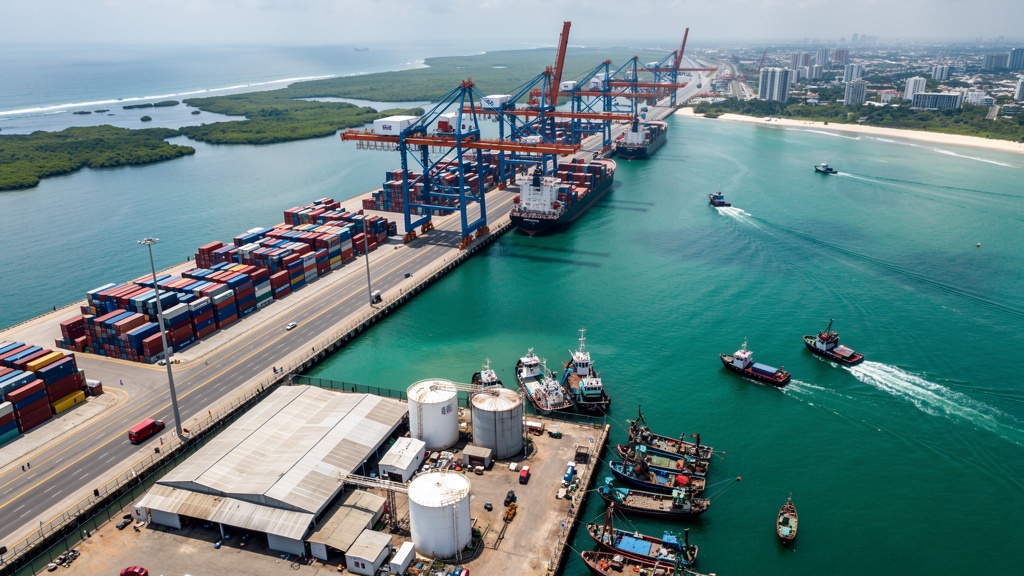
A major Indian seaport at golden-hour light, with stacked containers, gantry cranes and a deep-water berth for large vessels.
Ports — the largest single line item in India’s blue-economy aggregate, and a load centre for coastal renewable energy.
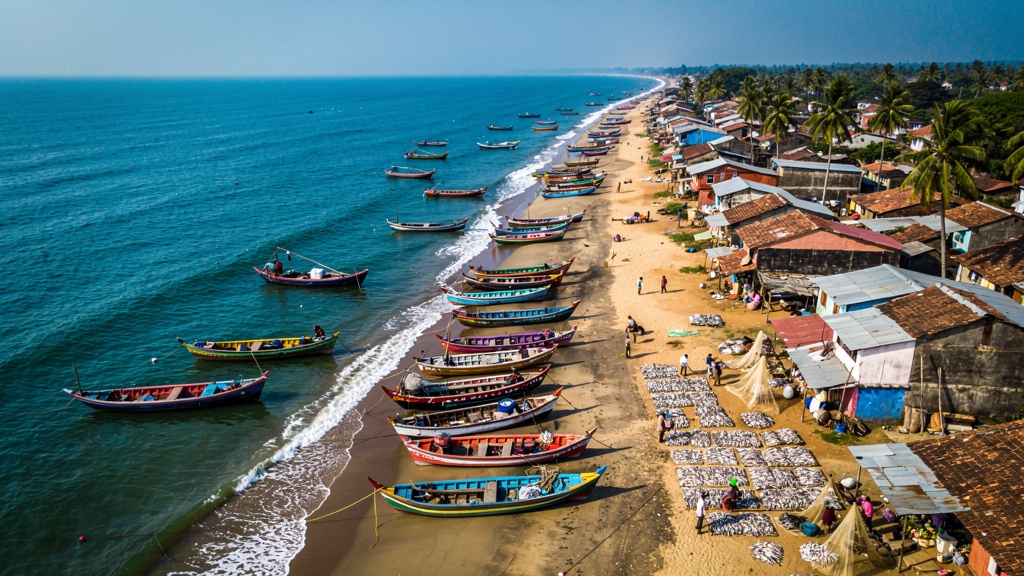
A row of traditional Indian fishing villages along a sandy coastline with catamarans pulled up on the beach at dawn.
Coastal villages — the human base of the blue economy, and the binding constituency for its policy.
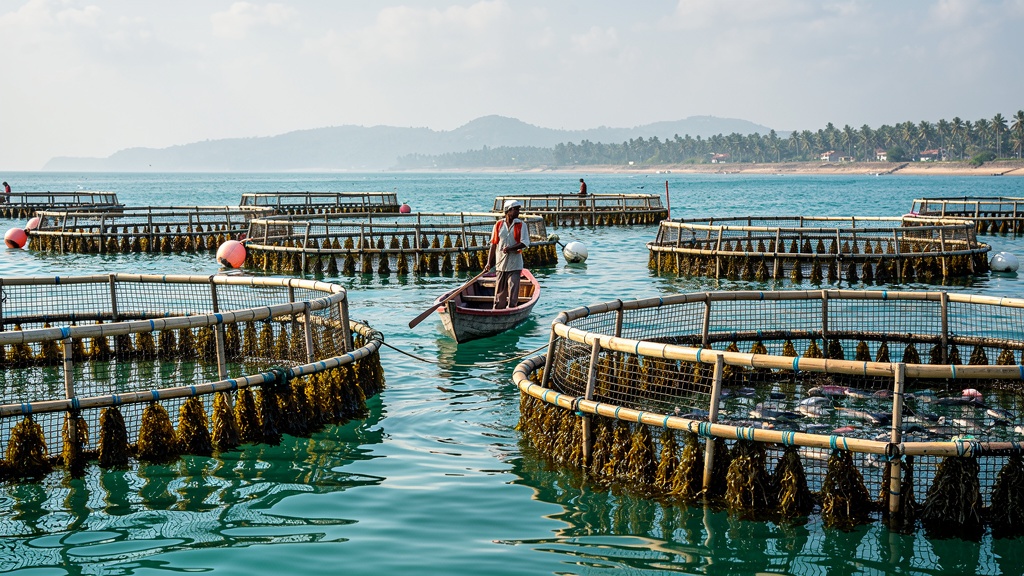
A sustainable aquaculture farm infrastructure on a calm Indian estuary, with floating cages and a sunset backdrop.
Aquaculture and brackish-water cultivation — a growth channel inside the blue-economy typology.
Definition

What blue economy actually means

Three widely-used definitions, applied to India, give different shades of meaning but converge on a common core: sustainable use of ocean resources for inclusive economic growth.

World Bank (working)

“Sustainable use of ocean resources for economic growth, improved livelihoods, and jobs while preserving the health of ocean ecosystems.” In practice: a working frame for green accounting and ocean-impact reporting, agnostic of renewable energy as such.

India’s Economic Advisory Council

PM-EAC has published a working figure for India’s realisable blue-economy value-add at ₹3.5 lakh crore per annum, against an estimated potential of about three to four times that figure. The composition includes coastal shipping, ports, fisheries, coastal tourism, marine biotech, deep-sea mining and ocean energy.

India’s Draft Blue Economy Policy, 2021

“A draft policy framework for the blue economy and ocean development” under the MoES, intended to align the various ministries with a unified ocean-development frame. Ocean energy is one of seven pillars, alongside fisheries, ports and shipping, marine biotech, marine biology, deep-sea minerals and coastal-tourism.

Where blue energy sits inside blue economy

The seven pillars, annotated

The Draft Blue Economy Policy 2021 plus subsequent working papers describe a typology of seven pillars. Blue energy sits at the intersection of the energy pillar and the coastal-zones pillar; below is a clean reading of the typology.

Pillar Anchor instruments in India Where blue energy intersects
Fisheries and aquaculture PMMSY (Pradhan Mantri Matsya Sampada Yojana); Coastal Aquaculture Authority Act. OTEC-LTTD plants can co-locate with aquaculture using cold-water discharge to support marine-crop production; hybrid platforms can integrate floating aquaculture with offshore wind.
Ports, harbours and shipping Sagarmala Programme; Major Port Authorities Act 2021. Port microgrids, cold-ironing using offshore-wind generation, OTEC-LTTD at port sites to supply both freshwater and electricity.
Marine biotechnology, pharmaceuticals MoES/DOM sub-mission; DBT marine biology programmes. Resource survey and biodiversity mapping carry joint benefit with OTEC deep-water surveys.
Coastal and marine tourism Swadesh Darshan 2.0; state tourism policies; PRASAD scheme. Tourism amenity-versus-turbine visual impact is binding; OTEC and offshore-wind zones must avoid tourist corridors or be co-designed with onshore-marine tourism.
Coastal and marine spatial planning CRZ Notification 2019; ICZM framework. Marine spatial planning is the foundational enabler for marine-renewable leasing; without it, the consenting timeline for an offshore project becomes site-specific and possibly indefinite.
Ocean energy Deep Ocean Mission fifth sub-mission; offshore-wind framework; OTEC-LTTD pilots under NIOT. This is the relevant pillar for the whole site; it is one of seven, not the dominant one.
Deep-sea minerals Deep Ocean Mission second sub-mission; International Seabed Authority licences. Marginal connection with blue energy; deep-sea exploration ships may carry OTEC and marine-survey-class instrumentation that bridge back to ocean-energy R&D.
The headline figure

What ₹3.5 lakh crore is, and is not

The Economic Advisory Council’s 2022 working figure of ₹3.5 lakh crore is the most-cited single number for India’s blue economy. The figure requires a clean read.

What ₹3.5 lakh crore covers

  • Coastal and offshore fisheries (including aquaculture) at ₹~70,000 crore.
  • Marine transport and ports at ₹~85,000 crore in added value, with cargo traffic at 1.5+ billion tonnes annually.
  • Coastal tourism at ₹~25,000 crore.
  • Marine biotech, pharmaceuticals and offshore construction at ₹~15,000 crore.
  • Marine minerals, oil-and-gas offshore at ₹~85,000 crore.
  • Offshore renewables at ₹~5,000–10,000 crore (operative figure depends on whether floating PV on inland reservoirs is included).
  • Marine services, mid-stream and education at ₹~40,000 crore.

What it does not

  • It is not a single national-accounts aggregate; it is a sum of value-add across ministries that use different classifications.
  • It does not include inland fish farming that is not ocean-linked.
  • It does not include the in-situ ecological value of mangroves, sea-grass beds, or coastal reefs except where a Sustainable Development Goal accounting has been done.
  • It does not reflect marine biodiversity loss or ecosystem-service cost. Inclusive blue-economy frameworks are aware of this gap but have not yet been adopted in Indian national accounts.
How to read the ₹3.5 lakh crore figure. The figure is a working aggregate. The smallest contribution line item is marine renewables — at this scale, blue energy is well under 2% of the blue-economy aggregate by value, and it will remain that way for at least another decade. The relevance of blue energy within blue economy rises sharply only if the technology and tariff path described on the Pros & Cons and Policy pages closes material gaps.
The policy stack

Five Indian policy families that frame the blue economy

None are blue-economy-specific, but together they form the legal and financial stack under which ocean industries operate. Each one intersects with marine renewables in a particular way.

PMMSY

Pradhan Mantri Matsya Sampada Yojana — scheme for doubling fisheries income. The PMMSY formal inclusion of marine spatial planning alongside port modernisation makes the case for cross-ministry co-financing of marine-renewable pilots. ₹20,050 crore in total envelope over 2020–2025.

Sagarmala

The Sagarmala Programme, since 2015 under the Ministry of Ports, Shipping and Waterways, has funded port modernisation, coastal shipping and cruise tourism. Sagarmala-related port microgrids have been an early entry point for OTEC-LTTD and offshore-wind grid evacuation.

SAGAR

The Prime Minister’s SAGAR vision (Security and Growth for All in the Region) is the regional-cooperation frame — a diplomatic and security umbrella under which India’s relationship with the Indian Ocean Region is exercised. It does not directly finance blue-energy projects but provides the geopolitical ceiling under which offshore-wind diplomacy and island-territorial questions sit.

Deep Ocean Mission

The MoES umbrella covering deep-sea biodiversity, deep-sea minerals, ocean climate advisory services, underwater vehicles, ocean-energy-and-desalination, and marine-biology research. This is the closest policy frame to marine renewables.

State Maritime Boards and Coastal-Zone Plans

Each coastal state has a Maritime Board (in most cases) and a Coastal Zone Management Plan under the CRZ Notification 2019. These are the operational instruments under which a marine-renewable project is locally consenting; they are also the instruments most variable in effectiveness across states.

Quasi-fiscal instruments

VGF under MNRE, capital subsidy under MoES/DOM, INR-denominated bond issuance for port-infrastructure projects, INSPIRE-style fellowships for marine-biology R&D. These together underwrite the cost gap when an ocean-energy project’s LCOE exceeds the off-taker’s tariff envelope.

The World Bank framing

Why the World Bank definition matters in India

The World Bank’s blue-economy programme emphasises the inclusive growth angle alongside the conservation angle. That framing has shaped how India’s ministry-level blue-economy working groups approach the question.

Sustainability gate

The inclusive framing requires that no blue-economy increment costs more in ecosystem-service loss than it adds in economic value. For blue energy, this is binding on tidal-barrage site selection, on wave-energy corridor designation, and on the EIA that each offshore project must clear.

Inclusive growth gate

The inclusive framing requires that the increment reaches the small-scale fishing and aquaculture community, not only the offshore industry. For blue energy, this means the fishing-panchayat consent process is not a checkbox but a binding condition.

Economic-growth gate

The inclusive framing keeps the headline number — around ₹3.5 lakh crore value-add — realistic rather than aspirational. Otherwise an aspirational kind-of paper target looks good against the budget speech and quietly fails the year after.

Inclusive-blue-economy guard rails

What blue-economy policy requires of blue energy

If blue energy is to count as part of the inclusive blue economy rather than as an exception to it, three conditions apply. They are not difficult to state; they are difficult to operationalise.

1. No net loss of marine habitat

Each project must be screened against its site-specific ecosystem service baseline. For tidal-barrage, this is siltation at the receiving estuary; for offshore wind, collision risk for migratory shorebirds; for OTEC, nutrient flux at the discharge point; for salinity gradient, brine concentration in the receiving estuary. The screening uses site data, not modelled prediction.

2. Inclusion of small-scale fishing

The fishing panchayat is consulted with mapped fishing-ground data, reasonable alternate-livelihood support, and compensation for reserve-zone loss. The consultation is a precondition, not a consultation that can be skipped because the developer consents.

3. Domestic supply-chain participation

India has a working principle that renewable-energy capacity additions should accrue domestic manufacturing content where it exists. For offshore wind, the principle is harder because India does not yet produce 14 MW-class turbines domestically; for OTEC cold-water pipes and for floating PV floats, the principle is supported by a domestic supply chain that is already operating at small scale.

4. Transparent data

Each project publishes operating data — capacity factor, downtime, environmental monitoring — to a publicly accessible instrument. INCOIS for resource data, NIOT for OTEC and LTTD data, SECI for tender outcomes, MNRE for FPV pilots. India is moving on this, with the Integrated Ocean Energy Atlas as a flagship instrument.

The two dozen disambiguation points

Why “blue” is so over-loaded in the Indian conversation

“Blue” has been applied to so many Indian policy and industry frames that confusion is the rule. The home-page disambiguation table summarises the most common confusions; below is the deeper reading.

Term Field Connection to blue energy
Blue economy Policy / economics The wider frame; blue energy is one of seven pillars.
Blue hydrogen Hydrogen production Not related; hydrogen from natural gas with carbon capture. Different colour, different stream.
Blue carbon Climate / ecology Carbon sequestered in mangroves, sea-grass and coastal wetlands. Adjacent because mangrove preservation is a guard rail for tidal and OTEC deployment.
BLUE Economy branding in tournaments Sports and events Unrelated. India has used “Blue Economy” sponsorship labels in some events.
Blue Energy Motors EV manufacturer (Delhi-NCR) Different company. Blue Energy is the bluish ocean-energy space; Blue Energy Motors makes electric trucks, named after a blue-pigment technology.
Blue flag beaches Tourism certification Unrelated. Blue Flag is a Denmark-originating certification for bathing-water quality on beaches.
Bharat Mala / Sagarmala blue connectivity Infrastructure Adjacent. Sagarmala funds port-side infrastructure relevant to OTEC and offshore wind grid evacuation.
Frequently asked

Questions about blue economy and blue energy, answered

Is blue energy renewable energy — or just ocean-derived?

It is renewable energy. The energy in a wave, the rise and fall of a tide, the temperature difference between surface and deep ocean, the salt difference between river and ocean — all are continuously replenished by solar and lunar gravitational input. The technology classes that tap them are renewable in the sense that renewable energy is used in policy terms: continuously available without fossil-fuel replenishment.

Is blue energy part of the SAGAR-vision budget?

SAGAR is a diplomatic and security frame, not a budget head. It is not a budget line under which a blue-energy project can directly receive a grant. SAGAR sets the geopolitical ceiling under which Blue Economy schemes are coordinated across India’s neighbours and Indian-Ocean region. The actual budget head for an ocean-energy project sits under MNRE, MoES/DOM or state.

What share of blue economy is blue energy?

Below 2% on the conservative current-value-add accounting. Marine transport, port cargo, fisheries, marine minerals and coastal tourism dominate the headline figure. Blue energy is one of seven pillars and is the smallest by value-add today. The share will rise only as serial fabrication brings LCOE into the band where marine renewables compete in tenders without VGF.

Will blue economy growth also grow blue energy?

Indirectly, yes. Blue-economy growth drives investment in port microgrids, coastal desalination, hybrid platforms and aquaculture-power colocation. Each of those has a marine-renewable adjunct. The growth path is not 1:1; if blue economy is ₹3.5 lakh crore today and ₹10 lakh crore in 2035, blue energy’s share will rise from below 2% to perhaps 4–6%, depending on tariff and consenting progress.

Does the Draft Blue Economy Policy 2021 explicitly mention marine renewables?

Yes, under Pillars 5 (Coastal-MSP) and 6 (Ocean Energy). The pillar 6 section frames the seven renewable-energy forms — wave, tidal, OTEC, salinity, ocean current, offshore wind and hybrids — as a single typology, and references MNRE, MoES/DOM and SECI as primary delivery bodies.

Is the blue-economy ₹3.5 lakh crore figure stable?

It is a 2022 working figure produced by the Economic Advisory Council against stated definitions and ministry-level data. It is not a national-accounts aggregate. Updates should be expected as the methodology harmonises with national-accounts revisions and as the Deep Ocean Mission sub-mission instruments bring fresh resource data into the picture.

How does blue-economy guard against greenwashing?

Through Marine Spatial Planning, EIA screening, fishing-panchayat consultation, and the public-domain data instruments such as INCOIS’s atlas and SECI’s tender tracking. None of these is bullet-proof. India’s blue-economy accounting instruments are still maturing.

Read the wider context

The disambiguation in this page sits inside the broader terminology on the What is Blue Energy page. For policy detail at the ministry level, see the Policy & Institutions page. For the resource at the upper end of the policy debate, see India’s Potential.