Cross-cutting concept

Hybrid floating renewable energy platforms in India

A single mooring can support offshore wind, floating PV, wave energy, ocean-current turbines — and an underwater cold-water pipe for OTEC. Co-locating them addresses each technology’s individual weakness: wind and wave don’t peak at the same times in many Indian cells, so a combined plant has a higher capacity factor and smoother output. Hybrid is the logical answer to intermittency on islands and to the high capex-per-MW of standalone ocean technologies.

Wind + PV + Wave + OTEC + storage Island baseload Capacity-factor gain Deep-water concession
How to read every ocean energy number on this site. Every statistic — the 9.2 lakh TWh headline, per-technology resource, hybrid plant capacities — is presented at four levels: resource potential (gross energy physically present in the sea cell), extractable potential (what a real device can capture at realistic efficiency), techno-economic potential (what is plausibly deployable at plausible cost with grid access) and project feasibility (what survives site-specific engineering, environmental and social screening). The largest number is always the resource potential. For any deployment-relevant figure, look at the techno-economic line. Simple sum-but-not-co-located resource potentials can mislead — the hybrid value is in capacity-factor smoothing, not headline GWh.

Why hybrid is gaining attention

The case for combining ocean renewables on a single platform is academic, industrial and policy-driven. None of these are new, but in the 2020–2025 window they have all become quantitatively stronger:

  1. Academic — peer-reviewed comparisons of capacity factors across technologies at the same Indian cell increasingly show co-located hybrids out-perform single technology plants on annual energy delivery per unit capex.
  2. Industrial — monopile and floating-platform supply chains have matured enough that a single platform supporting multiple devices is no longer speculative.
  3. Policy — the INCOIS Integrated Ocean Energy Atlas itself invites this treatment through its 5 km grid across all forms. A cell that has both wind and wave is a candidate cell.
  4. Island economics — diesel displacement on islands stacks up well when the baseload is supplied by OTEC+LTTD and the variable load is supplied by wind+PV+wave with shared storage.
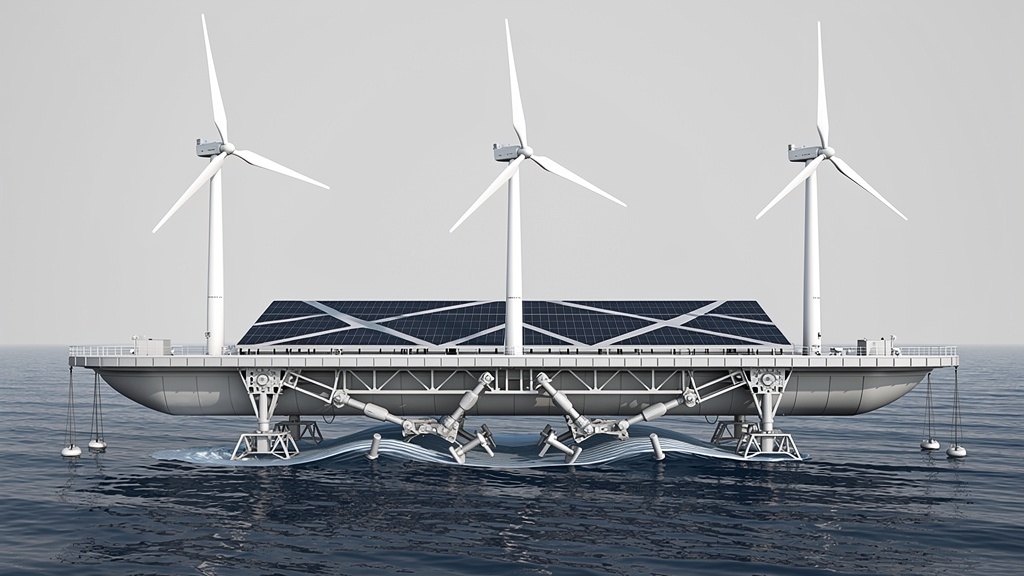
Concept rendering of a semi-submersible hybrid floating renewable energy platform — wind turbines on top, a small solar field on the deck, and wave energy converters attached to the hull, at sea.
Hybrid platform concept — multiple devices sharing a single mooring and grid connection.
Concept rendering of a hybrid floating renewable platform with wind turbines, solar field and wave energy converters attached.
Concept — a single mooring carrying multiple devices.
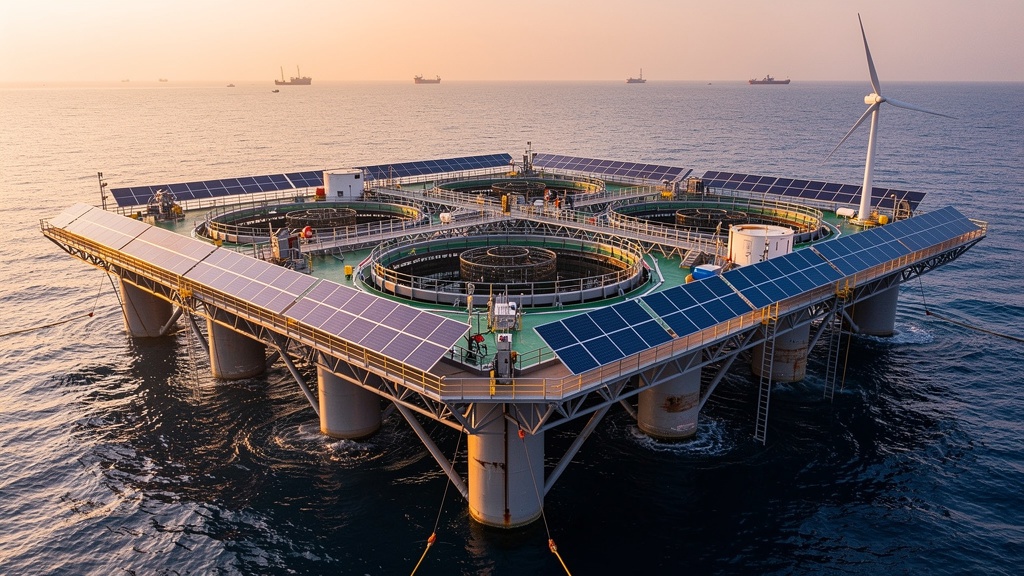
Photograph of a semi-submersible marine aquaculture farm with perimeter PV panels and a small wind turbine.
Co-location potential — an aquaculture platform with PV and small wind reduces marine-space competition.
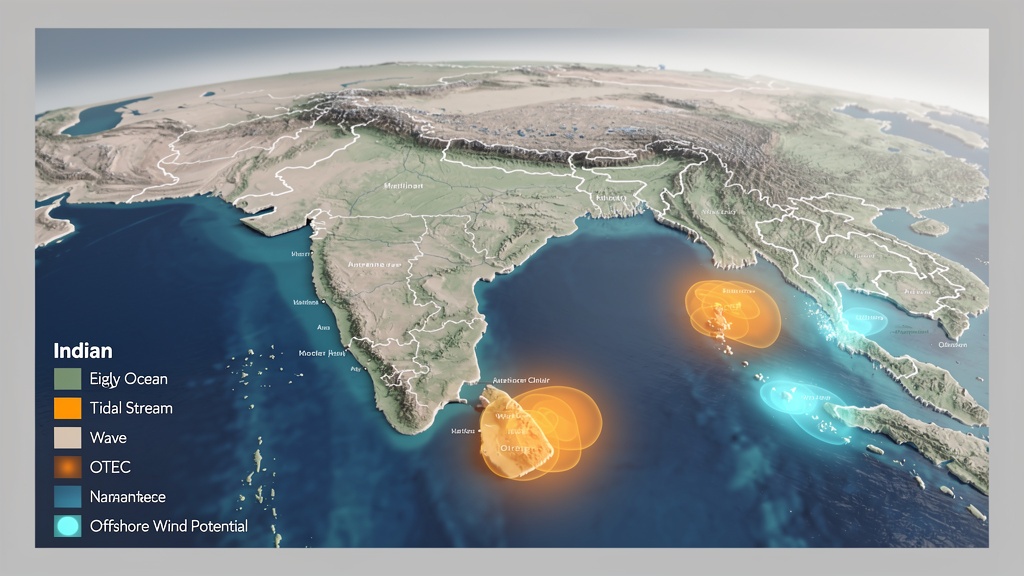
Stylised map of India surrounded by the Indian Ocean with glowing energy-resource hotspots.
INCOIS Integrated Atlas — identifying cells with multiple co-located resources.
Design framework

What a hybrid platform is and is not

A hybrid platform is not a magic consequence of attaching everything to everything. It is a designed engineering answer to a specific local optimisation problem: how to maximise the annual energy delivered per unit installed capex and per unit grid-room occupied, against a given offshore cell.

🧩

Things a hybrid platform shares

  • One hull or mooring system (capital cost spread across multiple devices).
  • One dynamic sub-sea cable and sub-station (transmission capex shared).
  • One O&M vessel schedule (cost shared across the same crew visits).
  • One monitoring and control system (data integration on a single architecture).
  • One environmental permit and one marine spatial planning framework.
⚠️

Things a hybrid platform does not automatically solve

  • Capacity factor of wind is unchanged by adding wave — capacity factor of the combined plant improves, but wind’s specific gap at calm seas is not eliminated.
  • Survivability — extreme events still target the most-loaded device (often the wind rotor).
  • Biofouling and corrosion — each subsystem has its own maintenance regime.
  • Engineering complexity — more devices means more interfaces, more failure modes, more commissioning steps.
  • Storage — variable output still needs buffering for grid-quality delivery.
Capacity-factor thinking

How co-location improves capacity factor

Indian offshore cells show distinct correlation patterns among technologies:

  • Wave & wind
    On the south-west monsoon coast, wave and offshore wind tend to co-vary positively during the south-west monsoon and weakly negatively at other times. Designing for the joint envelope reduces variability through the year.
  • PV & wind
    Solar PV produces strongly during daytime in non-monsoon months; offshore wind is stronger at night and during the south-west monsoon. Co-locating reduces the day-night gap and the seasonal trough.
  • Current & wind
    Persistent ocean currents are weakly seasonal but contribute a steady baseline when wind is low. Small but real capacity-factor lift in cells where the current signature is reliable.
  • OTEC & LTTD
    Both are continuous, dispatchable, weakly seasonal. They are the strongest baseload element of an island hybrid, used jointly with PV/wind for the variable load.
Capacity-factor arithmetic example. A standalone offshore wind cell might deliver 35% capacity factor. Co-locate floating PV (15–20% historical CF at sea) and OTEC (75–85% baseload CF) on the same mooring with modest storage, and the combined plant’s annual capacity factor can climb materially — especially when storage buffers the day/night peak on island micro-grids.
Cell selection

Which Indian cells are hybrid candidates

Hybrid is most powerful where the Integrated Ocean Energy Atlas shows multiple co-located resources — strong wind and wave at the same cell, or a tropical OTEC site with simultaneous wind.

🌊

South-west coast — wind + wave

The Kerala–Karnataka–Goa coast during the south-west monsoon concentrates wind + wave together. Co-locating offshore wind and wave energy converters on a single mooring can address the wave-only intermittency issue.

🏝️

Lakshadweep — baseload hybrid

OTEC and LTTD provide continuous thermal-and-water baseload; floating PV supplies daytime peak; offshore wind supplements. Storage ties it together. The hybrid approach is most-mature for net-zero island energy in India.

🗺️

Andaman & Nicobar — wind + OTEC + PV

Deep tropical water plus significant surface wind plus cyclone-era design. A combined wind + OTEC + floating PV + storage hybrid with typhoon-rated foundations is on the realistic technical roadmap.

🧪

Kanyakumari deep water

The southern tip combines both monsoons, deep water close to shore, and historical wave + wind resource signatures. A combined wind + wave + salt-gradient inference is plausible at the right cells.

Status snapshot

Where hybrid platforms stand in India

Hybrid platforms — status snapshot
AspectStatus as of 2024–2025
Resource characterisationINCOIS Integrated Atlas supports cell-level hybrid identification.
Domestic pilotsMultiple island-scale OTEC-LTTD-PV pilots in Lakshadweep; academic publications on Kanyakumari wind-wave; one or two floating PV pilots underway in reservoir-and-sheltered contexts.
International pilotsHybrid wind-storage pilots in Taiwan, Japan; several European wind+wave+storage pilots.
Domestic supply chainFoundations and structural engineering partly in place from offshore-wind supply chains; cold-water pipe from NIOT experience; anchors and dynamic cabling imported.
Strongest frictionEngineering integration; storage at sea; permitting across multiple-use frameworks; O&M for combined arrays.
Realistic first volumeIsland baseload replacement (Lakshadweep, A&N); mid-2020s to early-2030s build-out if financing scales.

The honest economics of hybrid

A hybrid plant is more engineering work but fewer system costs. Realistic accounting:

  • Foundation is amortised over more kWh; per-kWh foundation cost drops.
  • Sub-sea cable cost is amortised across more devices; the marginal cable cost per device falls.
  • O&M costs benefit from joint vessel scheduling, although complexity (handling more device types) eats some of the gain.
  • Permitting cost structure depends on how marine-spatial-planning regimes treat co-located arrays — most jurisdictions are still working this out.

The result on paper is a meaningful LCOE reduction for a target cell in which the integrated atlas has wind and wave simultaneously available. On paper, the answer is robust. Off paper, the engineering risks of integration — control systems, anchoring dynamic loading, thermal coupling — are real and have to be designed into the project.

Storage is part of the hybrid

A hybrid without storage delivers variable output; a hybrid with storage delivers dispatchable power. The most common storage choices at sea today:

  1. Battery storage on the platform — proven at pilot scale but constrained by mass, cost and thermal limits in marine ambient.
  2. Pumped hydro — for islands, land-based pumped storage back-stops the hybrid.
  3. Compressed-air or hydrogen — long-duration storage options, especially relevant when the offtake is a green-fuel facility.
  4. Load-side flexibility — green hydrogen, desalination or grid-side demand response — can absorb variability and is sometimes cheaper than bigger batteries.

Environmental and social considerations

Hybrid platforms concentrate the footprint into one concession, so the environmental burden is concentrated:

  • Single exclusion zone for fisheries (joint negotiation with coastal communities is part of project design).
  • Single permit pathway through CRZ, MoEFCC, MoD and state authorities.
  • Combined visual footprint — a wind-blade visible above the wave deck is potentially more intrusive than either alone.
  • Cumulative ecological pressure at the site — additive effects from multiple devices, not all of which are understood yet.

Honest outlook

  1. Hybrid platforms are the most likely application route for many of the smaller-maturity Indian blue-energy technologies. They will not displace standalone offshore wind; they will complement it.
  2. Island hybrid in Lakshadweep and A&N is where the technology stack is most aligned with the deployment case — baseload, water and electricity, capacity-factor smoothing by OTEC+LTTD.
  3. Deep-water hybrid off Kanyakumari and the southern tip carries wind + wave + current, plausible for early-next-decade pilots.
  4. Engineering integration remains the central research question; control-systems and integrated anchors are the topics Indian R&D is most active on for the rest of the decade.

See benefits & challenges for the wider cross-technology view and projects & technology for the current Indian pilot pipeline.

FAQ

Hybrid platforms questions

Is hybrid cheaper per MWh than standalone?
Yes — at the right cell. The LCOE benefit comes from shared foundation, cable, O&M and capacity factor. The LCOE penalty arises from added engineering, control-systems and integration complexity. The cell-by-cell answer depends on which effect dominates.
Is India piloting any?
Yes — at the island scale through Lakshadweep OTEC + LTTD + floating PV, and through academic pilots off the southern tip. Larger-scale wind + wave + storage pilots are likely to follow once the floating offshore wind EPC scale-up gets underway.
Does hybrid exist globally at scale?
Wind + storage pilots in several markets. Wave + wind pilots mostly pre-commercial. The most-cited newbuild at commercial scale is the Hexicon twin-turbine platform concept and various Taiwan offshore pilot platforms from 2023 onwards.
Should a state planner pick hybrid?
Where the cell-level Integrated Atlas shows co-located resources and the offtake can absorb the joint output (island baseload, green hydrogen, desalination), hybrid is usually preferable. Otherwise, explain the cell-level co-location advantage quantitatively before recommending hybrid over single technology.