Technology deep-dive

Ocean current energy in India

A persistent current carries far less kinetic energy than a tidal stream at the same speed — but it also runs all day, every day. The technology that exploits ocean currents (slow, broad, predictable flows such as the south-west monsoon drift and parts of the Somali Current) is a slow-spinning underwater turbine in the upper ocean. India’s resource sits mostly in cells away from the coast, which means cable runs are long and anchor engineering is non-trivial.

Slow, persistent flow Monsoon drift Somali Current Submerged turbines Distributed opportunity
How to read every ocean energy number on this site. Every statistic — the 9.2 lakh TWh headline, the “current speed cubed” map integration, pilot-plant capacities — is presented at four levels: resource potential (gross kinetic energy present in the current), extractable potential (what a real submerged turbine can capture at realistic efficiency and rotor area), techno-economic potential (what is plausibly deployable at plausible cost with the right sub-sea cable runs and anchoring) and project feasibility (what survives site-specific bathymetry, biofouling and monsoon-survivability requirements). The largest number is always the resource potential. For any deployment-relevant figure, look at the techno-economic line. Ocean current energy is at the pre-commercial stage globally.

What ocean current energy actually is

Ocean current energy is the kinetic energy of large-scale ocean circulation patterns — the general ocean circulation rather than tidal or wave energy. The distinction is not academic:

  • Tidal streams alternate with the tide — peaks and troughs structured by astronomical forcing.
  • Wave energy is concentrated near the surface and decays in deep water.
  • Ocean currents are broad, slow, persistent flows in the upper ocean, generated by wind forcing and by the global thermohaline circulation. They integrate across years, not hours.

The kinetic-power density of a current is proportional to the cube of stream speed. Practical design targets sit around 1–2 m/s routinely achievable mean speed at typical installations; the strongest signature currents reach 2–3 m/s over months at a time, but in the Indian Ocean this is more episodic.
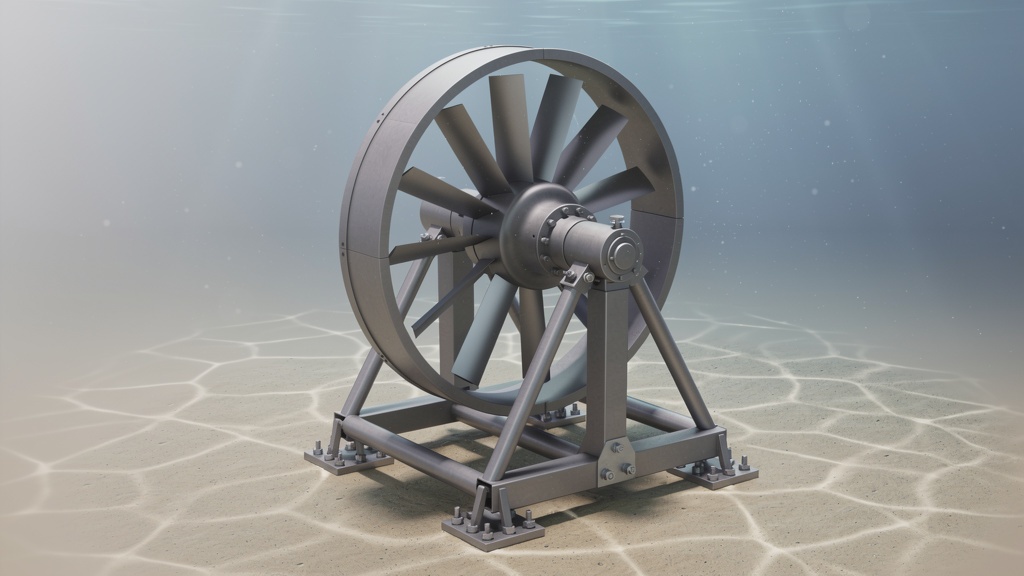
3D render of a slow-spinning underwater ocean current turbine with multiple rotor blades mounted on a steel frame on the seabed.
Submerged current turbines — large rotor area, slow rotation, deep mooring.
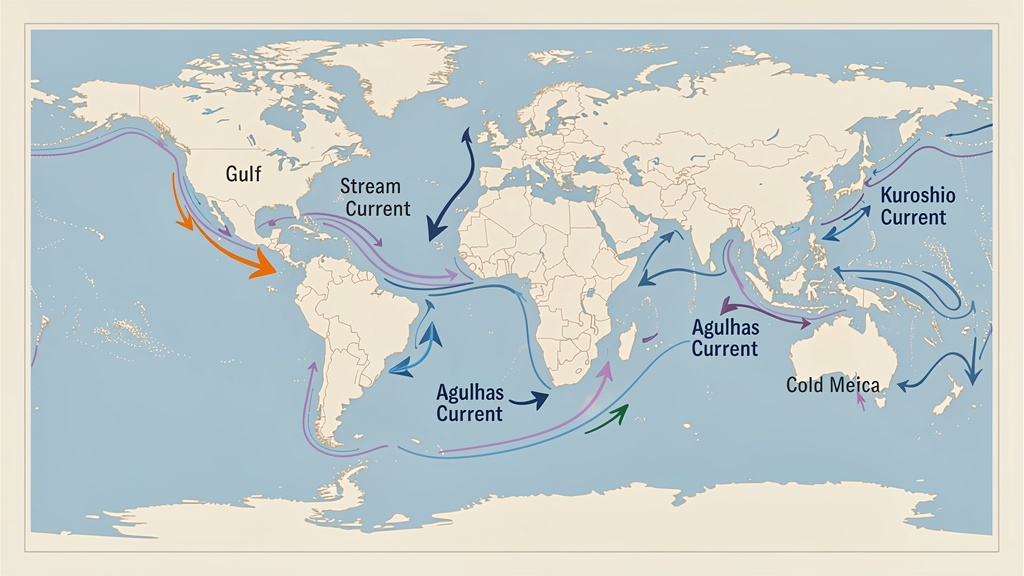
Educational world-map style illustration showing major world ocean currents such as the Gulf Stream, Kuroshio, and Agulhas with directional arrows.
World currents — the Gulf Stream and Kuroshio concentrate the densest global resource.
3D render of an underwater ocean current turbine mounted on a steel frame.
Submerged turbines are part wind-turbine, part marine propeller.
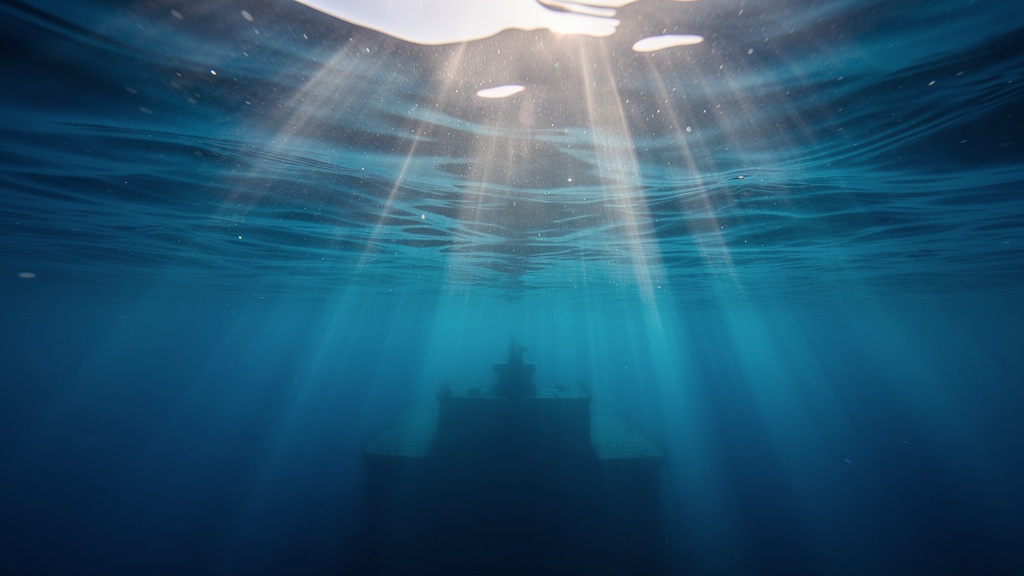
Underwater photograph looking up at sunlight rays filtering down through clear deep seawater with a submerged silhouette in the distance.
Submerged operating depth — typically 50–150 m below surface.
Indian Ocean specifics

Which Indian currents are the right target

India sits in a region where two large-scale current systems dominate: the south-west monsoon drift and the Somali Current (off the west coast of the subcontinent). Both are seasonal, both reach useful current speeds, and both are at significant distance from the coast — which shapes the engineering answer.

🌬️

South-west monsoon drift

Driven by south-west monsoon winds in May–September, with mean speeds typically 0.5–1.5 m/s in coastal waters, occasionally higher in choke points. Returns southward in the post-monsoon. Strong but seasonal.

🏁

Somali Current

A western-boundary current with the strongest seasonal reversal in the Indian Ocean. The northern part of the current, off Somalia, is the signature Indian-Ocean feature. Speeds reach 2 m/s at peak monsoon.

🌊

Bay of Bengal circulation

Eddy-rich, slower mean flow than the western side, with seasonal structure. Useful in scattered cells; less concentrated than the west.

🌅

Equatorial currents

The equatorial regions south of India carry both westward and eastward flows. Most useful cells for energy are far from shore.

The honest comparison

Why ocean currents are not the leading blue energy

Ocean current energy has two persistent advantages — predictability and capacity factor — but its critical density is materially lower than tidal stream at the same site. That puts it in a different engineering and economic niche.

Side-by-side: tidal stream vs ocean current
AspectTidal streamOcean current
Speed variabilityPredictable peaks and troughsSlow seasonal variation; stronger in monsoon
Typical peak speed2.5–4 m/s in good Indian channels0.8–2 m/s in good Indian cells
Where concentratedKhambhat, Sundarbans channelsOffshore, mostly mid-shelf
Distance from shoreOften close to shore, near portFrequently 50–200 km offshore
Capacity factor30–50% (predictable)30–60% (more uniform)
Key friction itemChannel ecology, navigationSub-sea cable cost, anchoring in deep water
Realistic Indian statusFeasibility stageResource characterisation; pre-pilot
Status snapshot

Ocean current energy in India today

Ocean current energy — what is measured, what is built
AspectStatus as of 2024–2025
Resource potentialDistributed across the open Indian Ocean; concentrated in cells of the south-west monsoon drift and Somali Current.
Deployed capacity (India)None. Pilot programmes exist overseas (SeaGen, USA/UK closed in earlier 2020s; Verdant Power, USA; several Japanese pilot devices); India is at resource-assessment stage.
International contextGlobal marine current energy remains at pre-commercial scale; notable commercial-scale closure events in mature pilots.
Strongest frictionSub-sea cable runs to shore; anchoring in deep water; remote-area O&M; capex per MW.
Realistic first roleComponent of integrated hybrid platforms co-located with floating wind and wave in the same concession.

Working principle in one paragraph

A current turbine is essentially an underwater wind turbine. The rotor sees a uniform vertical flow profile, extracts kinetic energy via lift-driven blades, and drives an internal generator. The rotor-swept area is large because the upstream flow speed is low. The rotor is mounted on a steel structure attached to the seabed or to a taut mooring. A typical installation operates at 30–60 m depth for surface currents and 80–150 m for stronger flows.

Environmental and social considerations

The footprint of a single current turbine per unit of energy is generally small. The cumulative impact of a farm of tens of turbines is the active research question:

  • Marine mammals — slow rotors in the lower velocity regime present less direct collision risk than fast wind rotors; the bioacoustics are still studied.
  • Fisheries — exclusion zones around a turbine field can overlap with artisanal fisheries; design can mitigate by placement.
  • Benthos — anchoring in productive shelf seabeds may affect benthic communities locally.
  • Sediment transport — long-term effects on sediment pathways are an open question.

Honest outlook

The intuition that ocean current is the lightest-touch form of blue energy — continuous, predictable, low visual footprint — is consistent with what the marine-engineering community has been saying for two decades. The intuition that ocean current is the shortest path to large-scale deployment — sits against the equally persistent observation that power density is low and cable runs are long. The most likely real-world outcome is that:

  1. Ocean current energy does not become a leading blue-energy form in India on its own.
  2. It becomes a meaningful contributor inside hybrid floating platforms in cells that already carry offshore wind and wave.
  3. The persistent capacity-factor advantage gives small but real value-add for island baseload schemes that combine offshore wind, ocean current and OTEC.

For Indian regional context see India’s potential; for the resource figures see the INCOIS Integrated Ocean Energy Atlas referenced on resources.

FAQ

Ocean current energy questions

Are ocean currents same as tidal streams?
No. Tidal streams oscillate with the tide (peak-trough twice a day, fortnightly spring-neap cycle); ocean currents are persistent, large-scale flows driven by wind and the general ocean circulation. They are different technologies with different siting and economics.
Is there a pilot in India?
No operating current turbine in Indian waters to date. INCOIS’s Integrated Ocean Energy Atlas identifies cells as candidates; an engineer-level pilot would follow once financing, marine permitting and mooring engineering come together — most plausibly as part of a hybrid floating platform.
Where is the strongest signature in India?
The south-west monsoon drift in offshore cells west of Gujarat and the southern tip, and parts of the Somali Current off the west coast. Magnitudes are episodic higher than typical open-ocean values, but still lower than the densest global cell.
Could ocean currents supply the Indian grid?
Not on their own within a realistic timeframe. Their natural role in India is as a component of a hybrid floating-generation portfolio — alongside offshore wind, floating PV and possibly wave — co-located at the same concession.