Technology deep-dive

OTEC & Low-Temperature Thermal Desalination in India

Ocean Thermal Energy Conversion (OTEC) and its sister technology, Low-Temperature Thermal Desalination (LTTD), exploit the same physical resource — the temperature difference between warm tropical surface water and cold deep water. India doesn’t just have the resource. It has operated LTTD plants at Kavaratti and Agatti in Lakshadweep, and is the only country in the world with a continuing at-sea programme of LTTD desalination as part of its island energy strategy.

Closed / open / hybrid cycle ΔT ≥ 20 °C Lakshadweep Andaman & Nicobar NIOT LTTD plants
How to read every ocean energy number on this site. Every statistic — 9.2 lakh TWh headline, per-form MW figures, NIOT plant capacities — is presented at four levels: resource potential (gross energy available in the thermal gradient), extractable potential (what a real OTEC or LTTD plant can deliver at realistic thermal efficiency), techno-economic potential (what is plausibly deployable at plausible cost, especially on islands currently on diesel) and project feasibility (what survives cold-pipe engineering, cold-water biofouling and site permitting). The largest number is always the resource potential. For any deployment-relevant figure, look at the techno-economic line.

The resource OTEC exploits

Solar heating of the tropical ocean surface produces warm surface water — typically 26–30 °C in the Indian seas — and the deep tropical ocean remains at 4–7 °C just below the permanent thermocline. The vertical temperature gap, ΔT, is the resource. OTEC requires ΔT typically ≥ 20 °C; LTTD needs a smaller ΔT (around 8–10 °C) because it is using the temperature difference to desalinate, not to expand a working fluid to drive a turbine.

The geographic requirement is therefore specific: a site where warm surface water sits above cold deep water close enough that a 1000 m cold-water pipe is feasible. For India, three geographies qualify:

  1. Lakshadweep — a coral atoll chain sitting on tropical water where the shelf drops to 800–1500 m deep only a few km offshore. India’s strongest OTEC footprint.
  2. Andaman & Nicobar — island chain with deep tropical water bathymetry and episodic typhoon exposure for surface plant designs.
  3. Off Kanyakumari and the southern tip — mainland India’s southern extreme has deep water not too far offshore; smaller ΔT in some cells.
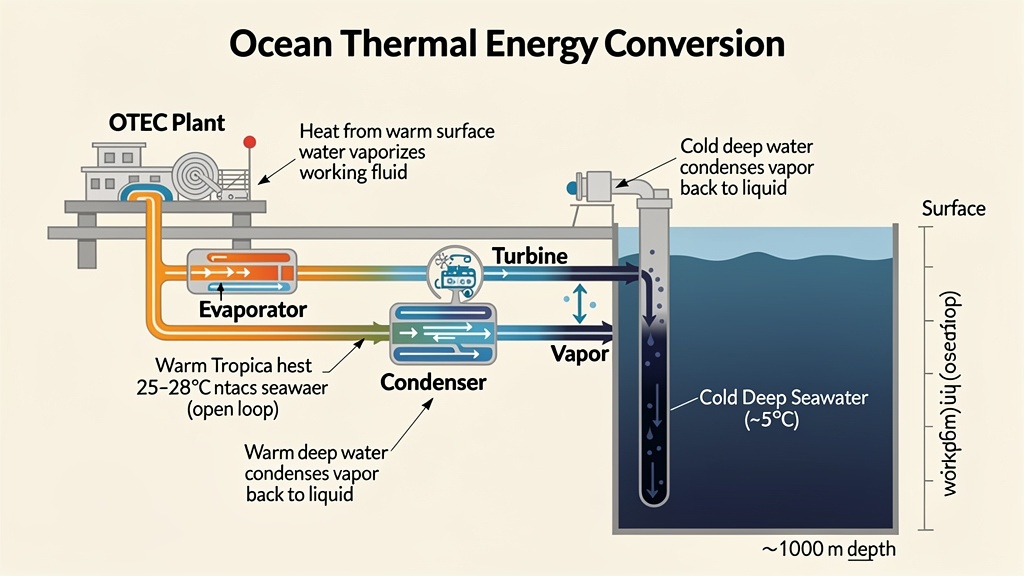
Stylised educational diagram of OTEC closed cycle: warm surface water vaporises a working fluid that drives a turbine; cold deep water condenses the fluid back to liquid.
Closed-cycle OTEC — warm-surface water vaporises a working fluid (commonly ammonia) that drives a turbine; cold deep water condenses it back to liquid so the loop can repeat.
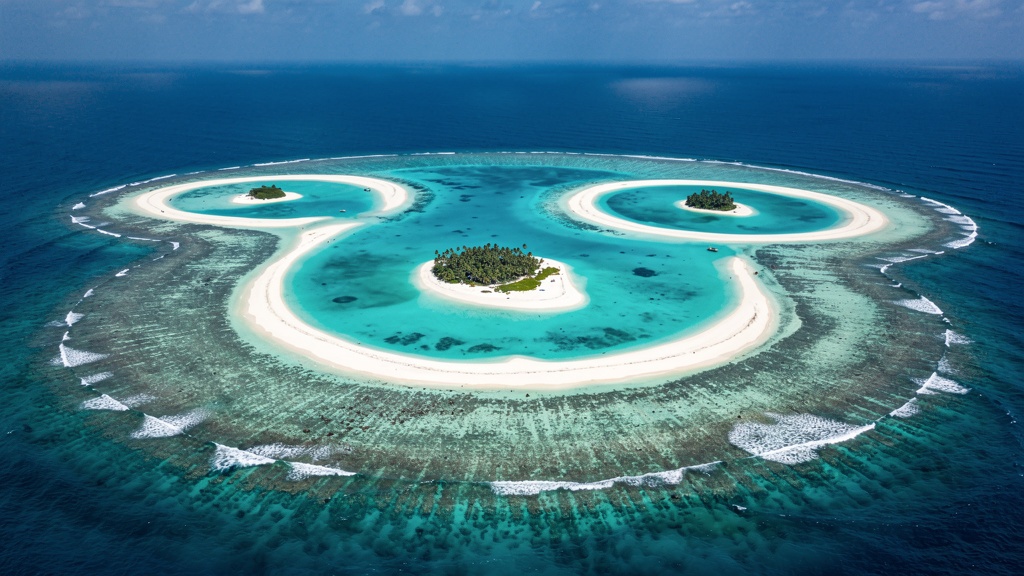
Aerial photograph of India’s Lakshadweep archipelago — turquoise lagoons, coral islands and deep blue ocean.
Lakshadweep — the most favourable Indian OTEC footprint, with deep cold water close to shore.
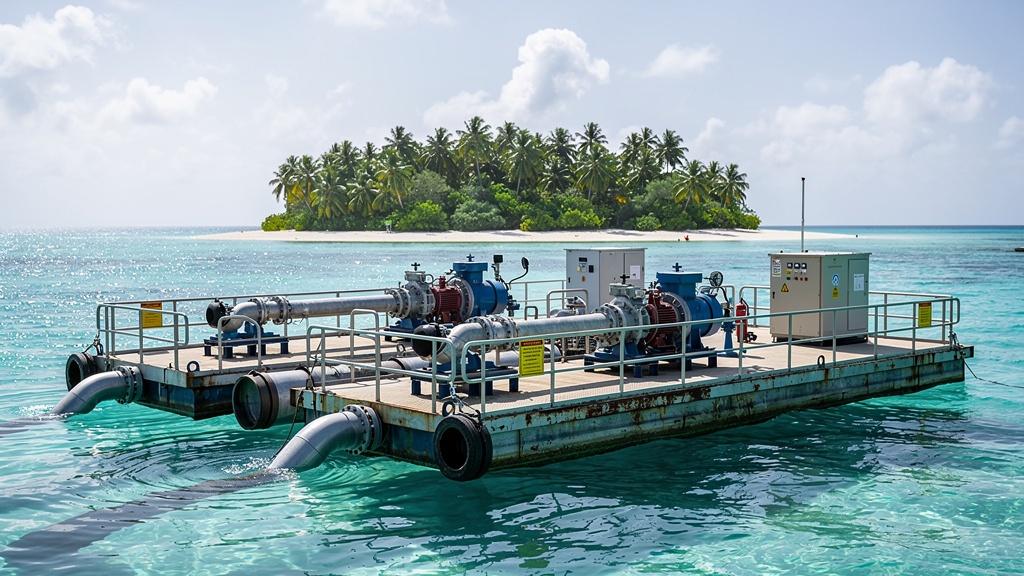
Small Low-Temperature Thermal Desalination (LTTD) barge platform with pipes set in a turquoise lagoon off Lakshadweep.
LTTD plants operate from shore-laid barges, drawing warm surface water and cold deep water through separate pipe runs.
Stylised educational diagram of OTEC closed cycle with warm and cold water flows.
The thermal engine at the heart of OTEC has been demonstrated at modest scale in the Indian context.
Cycle families

Closed cycle, open cycle and hybrid

Three OTEC families exist, with different engineering and water-product profiles. India’s installed base to date is LTTD — a derivative that exploits the same thermal gradient to make fresh water without making electricity.

♻️

Closed cycle

A working fluid (commonly ammonia) is vaporised by warm surface water, drives a turbine, condenses back to liquid over cold deep water, and recirculates. Power only — no water.

💧

Open cycle

Warm surface water is itself flash-evaporated in a low-pressure chamber; the steam drives a turbine; the steam is condensed by cold deep water to produce desalinated fresh water. Power + water.

🌐

Hybrid

Combines closed-cycle electricity generation with LTTD-style thermal desalination using waste heat. Useful when the consumer needs both power and water (typically an island).

Operational record

What India has actually operated

India is one of the few countries in the world to have operated thermal-gradient plants at non-trivial scale — LTTD rather than grid-power OTEC, but real industrial plants.

  • 2005 — first LTTD plant, Kavaratti
    NIOT commissions a 100 kW-class LTTD desalination plant producing ~100,000 litres/day of fresh water from the Laccadive Sea thermal gradient. The plant runs in island baseload desalination duty.
  • 2011–2012 — Agatti and Minicoy
    LTTD plants deployed at Agatti (150 kW, ~100,000 L/day) and Minicoy in successive years, with operational learning shared across sites.
  • 2010s — engineering learnings
    Operational data informs the cold-water pipe engineering community — biofouling, flow-induced vibration, marine growth — and feeds into ongoing OTEC-LTTD plant designs.
  • 2020s — deeper-water programmes
    NIOT and MoES explore deeper-water, higher-capacity LTTD-OTEC combinations near Lakshadweep and the Andaman & Nicobar chain, with international partner interest.

Source: NIOT annual and technical reports. See projects & technology for a consolidated list.

Status snapshot

Reality check: OTEC & LTTD today

OTEC & LTTD — what is measured, what is built, what is gated
AspectStatus as of 2024–2025
Resource potentialIndian cells with ΔT ≥ 20 °C confined to Lakshadweep, Andaman & Nicobar and the southern tip — broad cell-scale resource.
Techno-economic potentialTens of MW at the best island sites; constrained by cold-pipe engineering and biofouling.
Deployed capacityOperating LTTD plants at three Lakshadweep islands. No commercial grid OTEC plant.
Domestic device capabilityCold-water pipes, heat exchangers, pumps and barges assembled domestically with international partnership.
International contextClosed-cycle OTEC demonstration in Hawaii (USA, NELHA), open-cycle pilots in Japan, French Guiana, Tahiti (2010s).
Strongest use caseIsland baseload power-plus-water, displacing diesel generation and reverse-osmosis desalination.
Strongest frictionCold-water pipe engineering at scale; biofouling; remote-site logistics; capex per kW.

Why LTTD is the more important Indian variant

The honest framing is that LTTD — Low-Temperature Thermal Desalination — is what India has actually deployed. The argument for the technology is unusually clear in the island context:

  1. Many Indian islands depend on reverse-osmosis desalination, which is electricity-intensive. RO in remote locations means diesel, which means high fuel logistics.
  2. LTTD needs electrical pumps but no high-pressure pumps, no membranes, no chemicals — its thermal energy is free.
  3. The thermal output is a function of how much sea-water mass you can move through the warm and cold pipe loops, so the trade-off is pipe diameter × pipe length × pumping energy.
  4. Combined-cycle plants produce both electricity and water, which suits the joint power-water demand of an island community.

The cost of a fully delivered LTTD plant built to NIOT designs is non-trivial, but is consistently competitive with the equivalent diesel-plus-RO baseline when the displacement of diesel fuel and reverse-osmosis membrane replacement is priced in.

Compare the lifecycle, not the headline. A diesel generator plus reverse-osmosis unit also has a small headline capex, but operating a 200-kW diesel genset on an island means fuel logistics, RO membrane replacement every 5–7 years, and a maintenance footprint — none of which LTTD requires at the same intensity.

Cold-water pipe: the engineering bottleneck

The single biggest design constraint of OTEC is the cold-water pipe, which must:

  • Reach ~1000 m depth where the cold-water layer sits, on a coastline where the bathymetry allows it.
  • Survive biofouling, corrosion and storm currents at full ocean depth.
  • Maintain its shape under temperature differential, large hydrostatic pressure and vortex-induced vibration.
  • Be deployable from barges and small boats without recourse to large offshore construction vessels.

NIOT has built India’s most credible experience here, particularly through the Lakshadweep LTTD programme, and the engineering lessons are now influencing larger-scale offshore-wind monopile and sub-station footer design work.

Environmental and social considerations

The environmental footprint of OTEC and LTTD is genuinely small compared with most energy and water technologies. The plants draw and discharge sea water — warm and cold — in a controlled loop. Open-cycle OTEC additionally releases carbon dioxide concentrated from seawater at the surface.

Social considerations are dominated by:

  • Whether the displaced diesel leads to lower tariffs on islands — which depends on tariff cross-subsidisation policy.
  • Whether the desalinated fresh water reaches the whole community rather than a commercial enclave.
  • Whether the cold-water sludge and discharged brine have measurable local effects on reef and lagoon ecology — the principle is low impact; the studies continue.

The next 5 years

  1. Deeper and higher-capacity LTTD plants — particularly at Minicoy and the Andaman chain — with cold-water pipe design refinements.
  2. Hybrid OTEC-LTTD plants producing both electricity and fresh water for islands with power-plus-water demand.
  3. Co-location with floating PV — to deal with the plant’s auxiliary electrical load and produce a more balanced island energy mix.
  4. International partner interest in Indian deployment, given India’s at-sea experience is unusually strong.

See hybrid systems for how OTEC and LTTD combine with floating PV and offshore wind at the island scale, and blue economy for the wider island context.
FAQ

OTEC & LTTD questions

Is OTEC commercially competitive today?
No — Indian OTEC at grid scale remains pre-commercial. The deployed Indian program is LTTD desalination, which is a different question — and is competitive on a lifecycle basis for islands that currently rely on diesel-plus-RO.
Where exactly does OTEC work in India?
Lakshadweep is the most viable region, followed by the Andaman & Nicobar chain and a thin strip off the southern tip of the mainland. INCOIS’s Integrated Ocean Energy Atlas identifies cells elaborately; for a project, the next step is detailed bathymetry and metocean surveys at the proposed plant footprint.
Is the cold-water pipe the real bottleneck?
Yes. The cold-water pipe dominates the engineering risk and a substantial fraction of capex. India’s at-sea experience through NIOT is one of the most credible globally, and the lessons from Lakshadweep are now influencing other deep-water engineering projects.
What does LTTD mean for an island community?
LTTD gives a community a local source of fresh water that is not dependent on diesel-driven reverse osmosis. In a small Lakshadweep island that means fewer fuel shipments, no RO membrane replacement cycle, less noise from gensets, and a quieter step forward in energy self-sufficiency.