Technology deep-dive

Tidal energy in India

No other form of “blue energy” is as concentrated in time as tidal: the Gulf of Khambhat has some of the highest tidal ranges in the world, the Gulf of Kutch has a remarkable single-basin geometry, and the Sundarbans channels carry long-channel tidal streams. Tidal is the form with the longest global track record (La Rance, France, since 1966), but also the form whose environmental questions are most concentrated on a small number of sites.

Three technologies Khambhat feasibility Sundarbans Eco-system gated
How to read every ocean energy number on this site. Every statistic — tidal range in metres, “GWh/yr at Khambhat”, pilot capacity figures — is presented at four levels: resource potential (gross tidal energy present in a bay or channel), extractable potential (what a real barrage or stream array can capture at realistic efficiency), techno-economic potential (what is plausibly deployable at plausible cost with grid access) and project feasibility (what survives site-specific engineering, environmental and social screening). The largest number is always the resource potential and is almost never what gets built. For any deployment-relevant figure, look at the techno-economic line. In tidal specifically, the resource-to-deployment ratio is heavily compressed by ecological and civil-engineering limits, so the gap between resource and techno-economic potential is especially large.

Why tidal resource is concentrated

Tidal energy ultimately comes from the rotational coupling between Earth, Moon and Sun — the same astronomical forcing that produces ocean tides. Predictable is the buy-word: a half-century of tide-gauge data tells you a site’s tidal range to within centimetres. The catch is that the resource is concentrated into a small number of bay-and-channel geometries that amplify the astronomical tide.

Three Indian sites are repeatedly identified by INCOIS and feasibility studies because they share this geometry:

  1. Gulf of Khambhat, Gujarat — a funnel-shaped bay with spring tidal ranges commonly cited at 8–11 m and high tidal-stream velocities in the narrower reach. The most-studied Indian site.
  2. Gulf of Kutch, Gujarat — a smaller but tidally-significant basin north of the Kathiawar peninsula.
  3. Sundarbans channels, West Bengal — a network of tidal channels through mangrove islands, with strong tidal-stream flow in channels despite a more modest bay-as-amplifier geometry.

Other Indian sites show interesting signatures — Chilika lagoon, Odisha, parts of the Andaman & Nicobar channel network, parts of the Palk Bay — but at present have only preliminary resource studies.

Predictability matters. Unlike wave (which is sensitive to weather in the fetch zone) or offshore wind (which is sensitive to monsoon timing), tidal resource is astronomically determined, year-in-year-out. The downside is that the same predictability implies concentrated peaks followed by concentrated troughs — useful only where energy storage, dispatchable baseload or island self-supply fit that pattern.
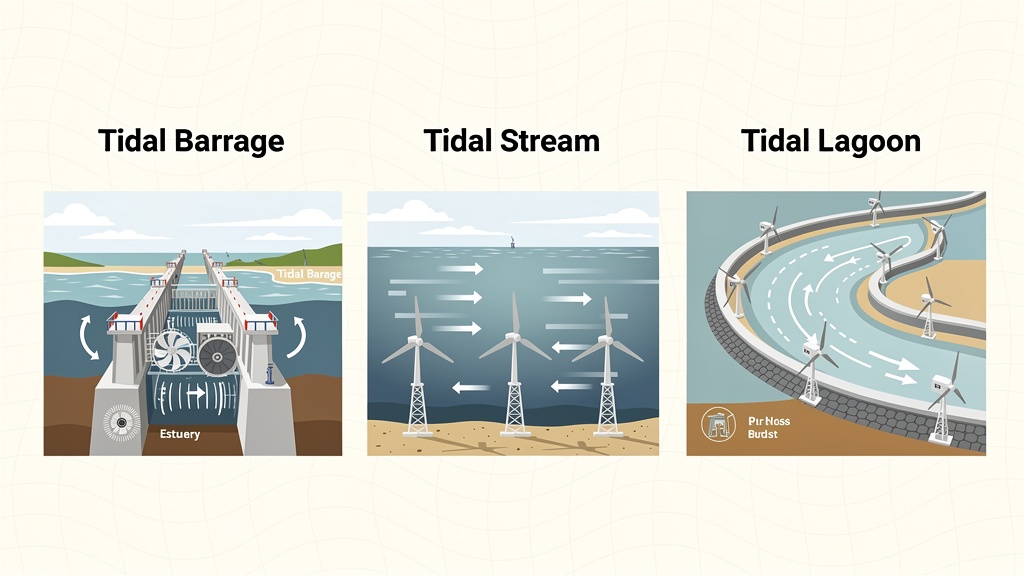
Educational cross-section infographic comparing tidal barrage, tidal stream and tidal lagoon systems.
Three tidal technologies — barrage, stream and lagoon — different footprint, different environmental footprint.
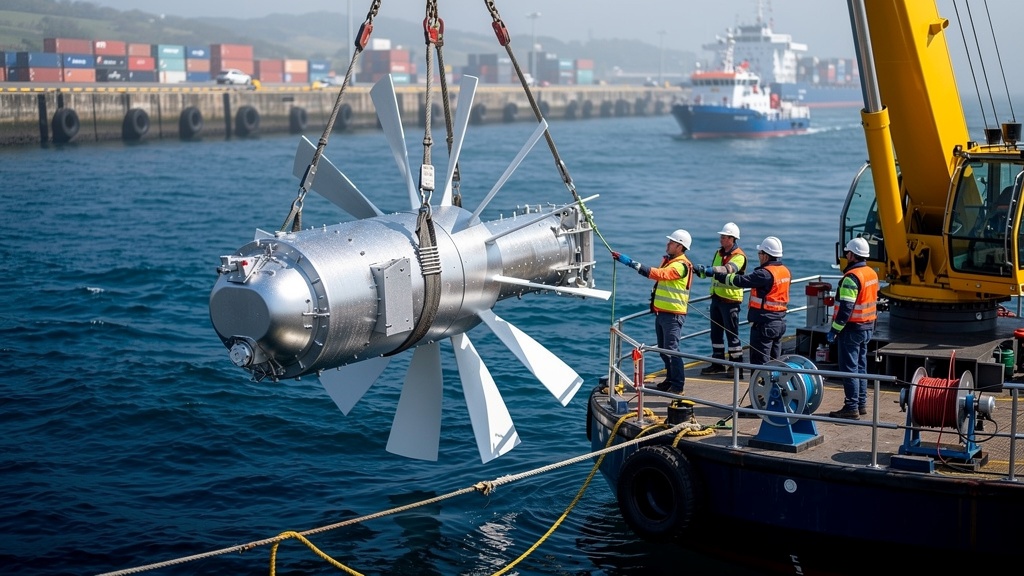
A tidal stream turbine being lowered into the sea from a small crane barge.
Tidal stream turbines look like submerged wind turbines.
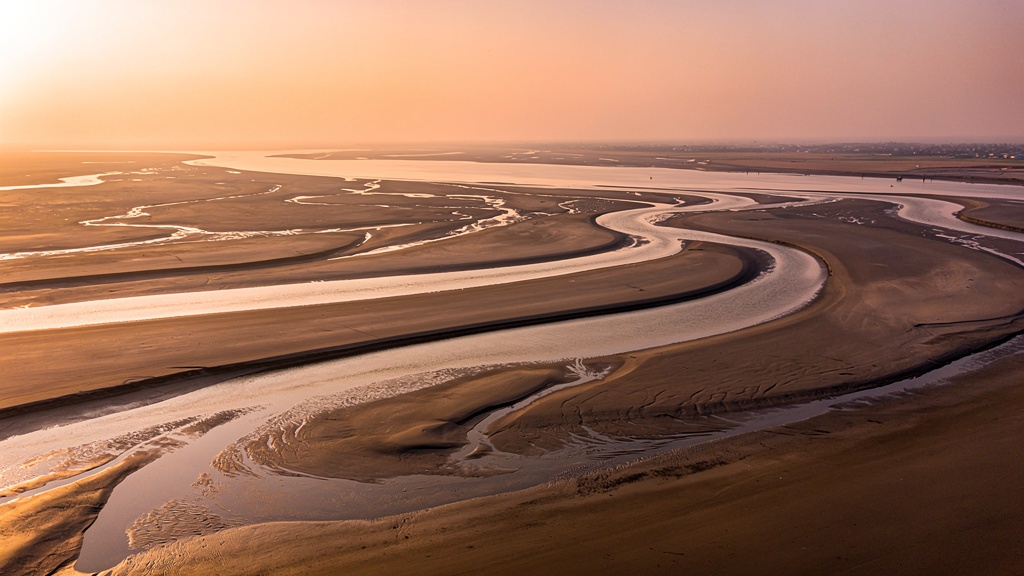
Aerial photograph of wide tidal mudflats at the Gulf of Khambhat at low tide.
Gulf of Khambhat — India’s most-studied tidal bay.
Three technologies, three trade-offs

Barrage, stream, lagoon — and why India has mostly studied the first two

Tidal is not one technology. Barrage, stream and lagoon exploit different parts of tidal motion and have materially different ecological footprints. Most Indian feasibility work has historically focused on barrage, with smaller parallel work on tidal stream. Lagoon has received the least attention.

🛑

Tidal barrage

A dam-like structure across a tidal bay holds water at one side; sluices open at the peak of the tide and water flows back through low-head turbines as the tide ebbs. Best where a natural bay provides amplification.

  • Strength: high output per installation, slow-rotation turbines, well-understood civil-engineering practice.
  • Weakness: large footprint, change to tidal flushing, sedimentation, fisheries displacement.
  • Indian precedent: Khambhat feasibility studies (1980s–2010s), Gulf of Kutch feasibility, Sundarbans delta proposals.
🌀

Tidal stream

Submerged turbines in a tidal channel or natural constriction; the flow drives rotors analogous to underwater wind turbines. Modular, lower civil-engineering footprint, sensitive to site bathymetry.

  • Strength: modular, can scale incrementally, lower local footprint than a barrage.
  • Weakness: needs high enough velocity (commonly accepted design target above ~2.5 m/s at peak), biofouling, O&M access.
  • Indian precedent: Sundarbans channel proposals, mini-turbine experiments.
🏞️

Tidal lagoon

An enclosed coastal reservoir built off the natural coastline, filled through sluices or turbines by the rising tide and emptied similarly on the ebb. Useful when a natural bay is unavailable but a coastal site can bear the construction.

  • Strength: can be sited where natural bays are absent; phaseable.
  • Weakness: large civil works, environmental impact similar to barrages, harder to share with other coastal uses.
  • Indian context: sparse; only preliminary proposals so far.
🏝️

The lagoon question for islands

For Lakshadweep and the Andaman & Nicobar Islands, lagoon geometry plus deep tidal flush could make small-lagoon sites attractive — but island biodiversity, tourism and fisheries sensitivities tend to gate deployment in practice.

Khambhat — the canonical Indian case study

The Gulf of Khambhat feasibility history

The Gulf of Khambhat is India’s most-studied tidal site, with feasibility work spanning four decades. Summarising the trajectory tells you a lot about the realistic pathway for any Indian tidal project.

  • 1980s — initial feasibility
    Gujarat State Electricity Board and central agencies look at the Gulf of Khambhat as a possible large barrage site; the high tidal range and bay geometry attract international partner interest.
  • 1990s — detailed feasibility, environmental review
    Multi-year site studies refine output estimates within a factor-of-two band; environmental scoping raises concerns about fisheries, silting and mangrove hydrography. No project is built.
  • 2000s — Sundarbans proposals
    Indian agencies and academic partners look at Sundarbans tidal-stream and barrage options; the social and environmental context raises significant fishery and displacement questions.
  • 2010s — re-evaluation under emerging standards
    Lessons from global tidal (La Rance retrofit, MeyGen build, Sihwa Lake output) feed into Indian re-evaluation; many reviews conclude that the ecological cost of Khambhat-scale barrage remains unresolved.
  • 2020s — INCOIS Atlas & integrated framing
    The Integrated Ocean Energy Atlas presents Khambhat as a specific tidal sub-cell within a national, multi-technological framing — alongside wave, OTEC, salinity and offshore wind — and electrifies the case for hybrid distributed alternatives.
Status snapshot

Where the numbers stand on tidal

Tidal energy in India — what’s measured, what’s built, what’s gated
AspectStatus as of 2024–2025
Resource potential (Khambhat)High spring tidal range (8–11 m); stream-flow estimates vary across studies but indicate a Gigawatt-scale theoretical ceiling.
Resource potential (Sundarbans)Distributed across many channels; aggregate estimate in the hundreds-of-MW range subject to environmental limits.
Techno-economic potential (barrage at Khambhat)Small fraction of resource once ecological buffer zones and MoD/MoEFCC exclusions are layered in.
Deployed capacityNo commercial-scale tidal project installed in India. Pilot and feasibility stages.
Domestic device capabilityLimited/tiny; most turbine, generator and barge systems would be imported.
International contextLa Rance in service since 1966; Sihwa Lake (Korea) is the largest operating tidal plant globally; MeyGen (UK) is the largest tidal-stream project. None at scale in the Global South.
Strongest frictionEnvironmental impact on tides, fisheries, mangroves, navigation; high civil capex; long permitting.

The environmental and social questions

Tidal’s reputation globally is that its engineering is solved and its environmental question is the active research front. For India the marginal questions are:

Barrage effects on a bay

A barrage alters the residence time of water inside the bay and the timing of tidal flushing. Effects documented in published reviews include:

  • Sediment accumulation upstream of the barrage, which can change delta evolution downstream.
  • Changes to fish migration patterns, particularly for species that follow tides into and out of the bay.
  • Changes to mangrove and intertidal benthic communities around the barrage foundations.
  • Visual and tourism impact on coastal amenity.

Tidal stream effects on a channel

A tidal-stream farm is more localised in disturbance, but the cumulative effect of tens of turbines across a small strait can affect flow patterns, navigation and acoustics for marine fauna.

Living-resource livelihoods

Indian coastal communities in Khambhat, Kutch and the Sundarbans depend critically on artisanal fisheries. Any tidal project in these regions must contend with the livelihood question as a primary, not secondary, design constraint.

Skip the framing shortcut. Phrases like “minimal ecological impact compared with fossil” are usually device-reflective and rarely bay-reflective. The bay is where the impact concentrates.

Indicative costs and economics

Indian tidal feasibility studies have quoted cost bands. As with the other marine renewables, treat these as project-dependent ranges, not headline tariffs:

  • Large barrage — typically the largest capex per MW of any ocean form because of immense civil works; siting constraints tend to make only one or two sites viable nationally.
  • Tidal-stream array — capex-heavy per MW because of bespoke turbines, sub-sea cabling and access; learning-curve hopes rest on standardising turbine modules.
  • Hybrid distributed — pair tidal stream with floating PV and small wind in the same concession; lower realised LCOE because of joint O&M and storage.

Globally, realised LCOE from operating tidal projects is broadly comparable to the upper end of offshore wind LCOE — and Indian capex will reflect Indian supply-chain dynamics once serious builds happen.

The honest outlook

If you read the IEA, IRENA and the IEA-OES implementation reports on tidal energy together, the picture for India is consistent:

  1. Khambhat-scale barrage is technically well-understood but its environmental and displacement toll means it is unlikely to be a near-term Indian project.
  2. Sundarbans tidal stream remains a credible pilot target — but needs to be designed within the brackish-water ecological framework from the start.
  3. Distributed tidal stream on small islands (Lakshadweep, Andaman & Nicobar) is a niche use case, sized to displace diesel at specific points of need.
  4. Lagoon remains sparsely studied in India; only preliminary proposals so far.

Tidal sits on a slower India trajectory than wave or OTEC broadly, because civil-footprint questions dominate the timeline. See benefits & challenges for the cross-technology view, and hybrid systems for the distributed alternative that may absorb many of the same opportunities.

FAQ

Tidal energy questions

Is Khambhat the best tidal site in India?
No single site is “best” universally — Khambhat has the largest single-basin resource but the largest civil and ecological footprint. Sundarbans channels have lower individual cell resource but a more distributed geometry that suits tidal stream arrays. The INCOIS Integrated Atlas evaluates both within a single national framework.
Why hasn’t the Khambhat barrage been built?
Feasibility has been refined across decades, but environmental impact on the bay’s tidal flushing, sediment transport, fisheries and the coastline near the barrage continues to gate the project. The honest reading is that the choice is not just engineering but ecological and political.
Is tidal stream cheaper than tidal barrage?
Tidal-stream turbines meaningfully reduce the civil-engineering footprint but require a careful site (high enough velocity, accessible for O&M, eco-system acceptable). Global learning curves suggest both forms will move toward similar LCOE with enough volume — but volume is what’s lacking in either Indian context.
What’s the largest tidal plant globally?
Sihwa Lake (South Korea) is the largest operating tidal plant globally, after a 2011 commissioning of a 254 MW tidal-stream array built into a seawall. La Rance (France) remains the longest-running example (since 1966) and was being refurbished through 2023–2024. MeyGen (Pentland Firth, Scotland) is the largest multi-turbine array with successively larger turbines installed.