Technology deep-dive

Offshore wind & floating solar in India

Offshore wind is the most mature member of India’s blue-energy family — with a national target of 30 GW by 2030, lease blocks identified off Gujarat and Tamil Nadu, and a National Offshore Wind Energy Policy in force since 2015. Floating offshore wind is on a slower trajectory, but is the form that opens up India’s deeper water resource. Floating solar is at a near-commercial scale in India already — though most deployed capacity sits on inland reservoirs — and is a natural partner for floating wind and offshore platforms.

30 GW by 2030 Fixed-bottom today Floating wind pilot Floating PV Gujarat & Tamil Nadu
How to read every ocean energy number on this site. Every statistic — the 9.2 lakh TWh headline, INCOIS wind resource figures, the 30 GW target, pilot-plant capacities — is presented at four levels: resource potential (gross wind or solar flux over a sea cell), extractable potential (what a real turbine or panel can capture at realistic efficiency), techno-economic potential (what is plausibly deployable at plausible cost with grid access and supply chain) and project feasibility (what survives site-specific permits, transmission and EPC execution). The largest number is always the resource potential. For any deployment-relevant figure, look at the techno-economic line.

Why this is India’s leading blue energy

Offshore wind and floating solar are the two forms of India’s blue-energy family for which global cost-curve trajectories are already favourable and Indian institutional capacity is already partly in place:

  • Onshore wind in India is a mature, bankable industry with a 40+ GW installed base. The supply chain foundations — blade manufacturing, tower fabrication, project finance — partly read across to offshore wind.
  • Solar PV in India has a 70+ GW installed base. Floating PV represents a different engineering challenge (modules on water, anchors, corrosion) but uses much of the same equipment family.
  • Transmission for grid-connected offshore wind sits in adjacent ministries (Power, MNRE, MoES) — the governance challenge is not whether the technology works, it is how to coordinate lease areas and onshore landing stations.
  • Financing is at a scale where the Indian banking system can absorb it, which is not the case for many other ocean-energy technologies.
Don’t equate “blue energy” with “non-mature.” Offshore wind and floating solar are technological cousins of mature onshore wind and ground-mounted PV — and they share the supply chain, finance and project-execution capacity of those industries, even though the marine engineering is new.
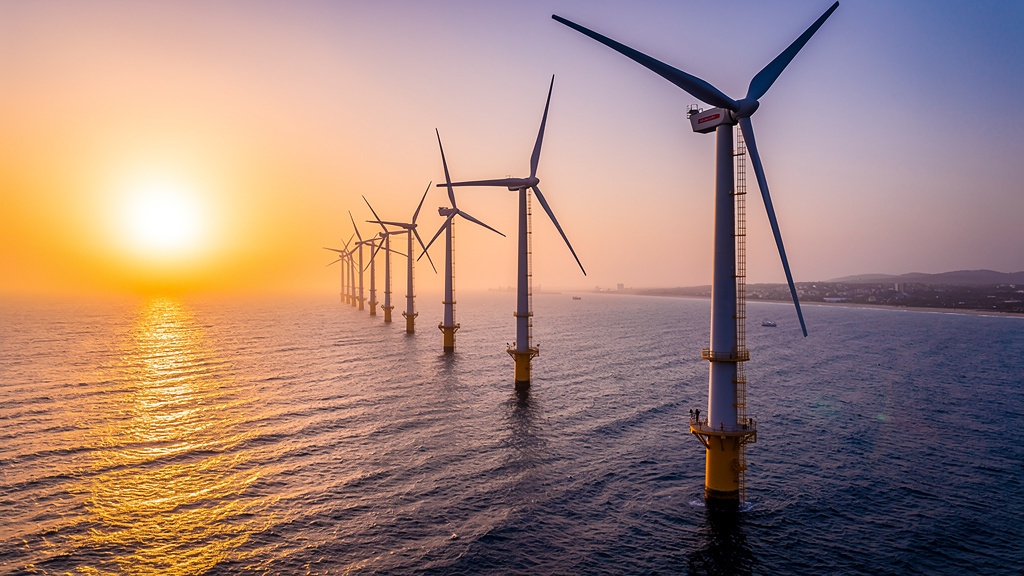
A row of offshore wind turbines standing in the Arabian Sea at sunset off India’s coast.
Offshore wind off India’s west coast — early industrial-scale deployments as part of the 30 GW target.
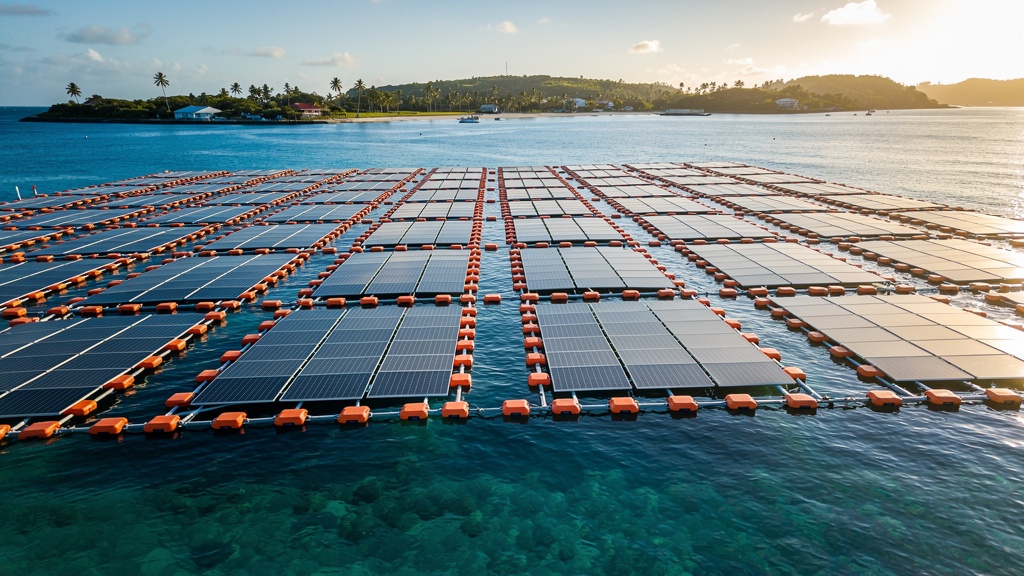
Aerial view of a large grid of floating solar panels in a calm blue tropical bay with anchored orange floats.
Floating PV — modules on water with anchoring, wiring and ballast.
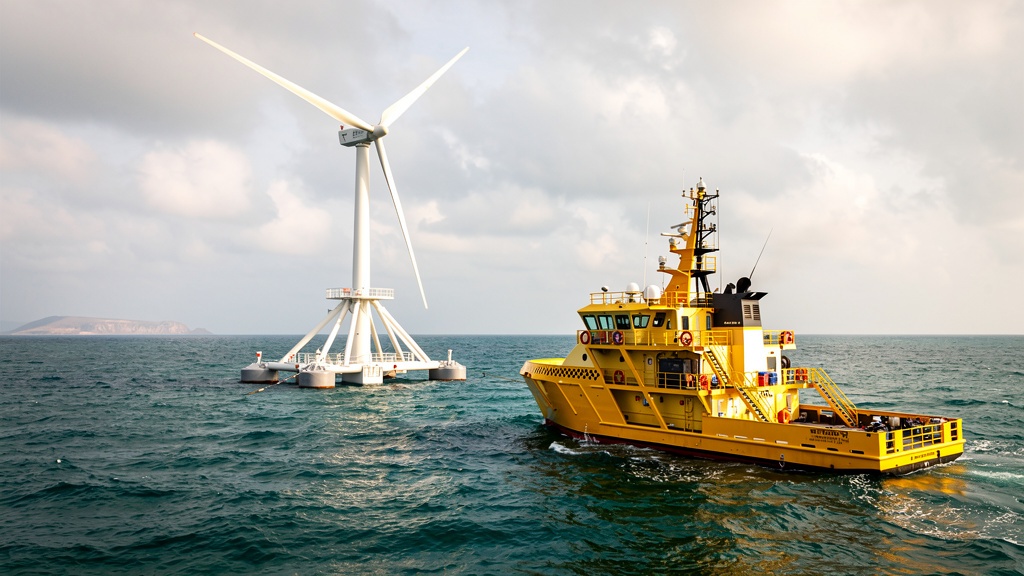
Photograph of a yellow offshore service vessel next to a large floating wind turbine prototype in the sea near India’s west coast.
Floating offshore wind — the form that opens up India’s deep-water EEZ resource.
Taxonomy

Fixed-bottom, floating, and the floating PV cousins

Three sub-families share the same generation physics (rotor / panel), but sit on very different engineering stacks.

🛠️

Fixed-bottom offshore wind

A traditional wind turbine installed on a steel monopile or jacket foundation driven into the seabed. Limited by seabed depth — typically economic at 30–50 m water depths; marginal beyond ~60 m.

  • Where in India: Gujarat coast, southern Tamil Nadu coast, parts of the Karnataka–Kerala coast.
  • Status: pilot and pre-commercial lease areas identified, awarded in 2022–2024 onwards.
  • Strength: proven technology globally; Indian supply chain partly in place.
  • Weakness: bottle-necked by water depth — most Indian high-quality wind resource is in deeper water than fixed-bottom economics comfortably allow.

Floating offshore wind

A wind turbine on a floating platform — semi-submersible, spar buoy or barge — anchored to the seabed with synthetic mooring lines. Tethers, not foundations, allow operation at 100–1000+ m depths.

  • Where in India: most of the high-quality offshore wind resource; deep water off Kanyakumari, off Rameswaram, off Mul Dwarka, off Konkan.
  • Status: pre-commercial globally; India is finalising the modelling and supply-chain strategy.
  • Strength: opens up the high-wind deep-water resource; smaller seabed footprint.
  • Weakness: anchor design, dynamic cabling, O&M access, capital cost still high.
☀️

Floating PV

Conventional PV modules mounted on floats anchored in a calm body of water. Reservoir-scale floating PV is already operating in India; marine floating PV is at pilot stage and the engineering requirements are more demanding (waves, salt, biofouling).

  • Where in India: many reservoir applications already deployed (Omkareshwar, Kayamkulam, etc.). Marine pilots targeted in coastal backwaters and sheltered bays.
  • Status: reservoir scale commercial; marine scale early pilot.
  • Strength: reduced land use; cooling effect on module temperature; co-location with hydro.
  • Weakness: marine-anodised corrosion, bio-fouling, severe-sea-state deployments need engineering.
🤝

Why hybrid floating renewable platforms matter

Several deep-water Indian cells carry more than one renewable resource — a combination of strong wind, moderate waves and consistent currents at the same time. Floating hybrid platforms combine these on a single mooring, sharing O&M, sub-sea cable and grid connection. They are a natural answer to the intermittency and capacity-factor problems facing standalone floating wind.

Policy timeline

Two decades of policy framework

India’s offshore wind policy framework is in place but evolving. The headline timeline:

  • 2015 — National Offshore Wind Energy Policy
    MNRE framework published: defines roles for MNRE, NIWE, state nodal agencies, transmission planning, RPO treatment. Initial lease area mapping off Gujarat and Tamil Nadu.
  • 2016 — NIWE Wind Atlas
    National Institute of Wind Energy publishes the Indian offshore wind atlas at 5 km resolution. MNRE begins site-specific resource measurements in identified lease zones.
  • 2018 — Express Transmission Policy
    PowerGrid framework for offshore-wind express transmission system connecting lease zones to onshore pooling stations.
  • 2022 — 30 GW by 2030 target
    MNRE reaffirms the national target of 30 GW offshore wind installed by 2030, split 15 GW Gujarat and 15 GW Tamil Nadu in initial phases; floating wind treated as the path to scale beyond this.
  • 2023 — INCOIS Integrated Ocean Atlas
    INCOIS publishes the Integrated Ocean Energy Atlas, integrating offshore wind with the rest of blue energy for the first time. Floating-wind sub-areas gain validity as part of a national multi-technology framing.
  • 2024 — first commercial lease awards
    First commercial offshore wind lease awards off Gujarat and southern Tamil Nadu, with project-execution milestones set.

Read alongside: policy & institutions and hybrid systems.

Where

State-by-state signals for offshore wind and floating PV

🟢

Gujarat

Identified as the first lease zone for fixed-bottom offshore wind, off the Gulf of Khambhat, with additional zones proposed off the Saurashtra coast. Co-location potential with tidal stream resource in the Gulf itself.

🟢

Tamil Nadu

The southern tip and the Rameswaram–Pamban stretch carry excellent wind resource. Hybrid floating platforms combining wind and wave are particularly relevant here. Existing onshore wind cluster helps supply-chain readiness.

🟡

Andhra Pradesh & Odisha

Bay-of-Bengal resource, lease-mapping still in early phases. Utility-scale floating PV in reservoir contexts provides analogous engineering experience.

🟡

Karnataka, Kerala, Goa, Maharashtra

West-coast floating wind and PV resource is meaningful but development is at earlier stage. Backwater-scale floating PV pilot projects plausible.

🟢

Lakshadweep, Andaman & Nicobar

Floating wind + floating PV + OTEC + LTTD + tidal stream combine into a credible distributed island hybrid arch — see hybrid systems.

🔵

Inland reservoirs

India’s deployed floating PV capacity — several hundred MW by end-2024 — sits on inland reservoirs where floats, anchors and grid connection are simpler. Useful engineering lessons read across to marine sites.

Status snapshot

Offshore wind & floating solar — what is measured, what is built

Offshore wind and floating solar — India status
AspectStatus as of 2024–2025
Resource potential (offshore wind)Multi-hundred GW theoretical across the EEZ, concentrated off Gujarat and Tamil Nadu at 5–9 m/s mean wind speed at hub height.
Resource potential (floating PV, marine)Patchy; site-specific. Reservoirs are already commercial, marine is at pilot stage.
Target30 GW offshore wind by 2030 (announced target; in progress).
Deployed capacityPre-commercial. First commercial lease awards off Gujarat and southern Tamil Nadu in 2024; floating-wind / marine PV pilots elsewhere.
Domestic supply chainFoundations, towers, blades partly onshore; offshore-specific foundations, dynamic cabling and floating platforms still being assembled.
International referenceEuropean offshore wind LCOE in early 2020s dropped below LCOE of new onshore wind in some markets; Asian markets (Taiwan, Japan) at scale with floating offshore wind pilots.
Strongest frictionTransmission build-out cost, port infrastructure, project finance structuring for first-of-its-kind builds.

Indicative capex and LCOE thinking

Indian capex figures published by MNRE, NIWE and leading developers put fixed-bottom offshore wind capex in the early-2020s band at roughly Rs 7–9 crore per installed MW. Floating offshore wind is higher because of platform and dynamic-cable costs at pilot scale — typically 25–40% above fixed-bottom at small scale, narrowing in long-run learning-curve scenarios. Floating PV capex sits closer to ground-mounted PV, with mild uplift for floats, anchors and corrosion management.

LCOE depends on capacity factor (which depends on wind regime), discount rate, debt-equity mix and the cost of finance. By 2030 most analyst scenarios put fixed-bottom Indian offshore wind LCOE at roughly Rs 4–6/kWh, materially above the lowest onshore wind and PV LCOEs, but competitive when co-located with green hydrogen or industrial offtake. Floating wind is expected to sit above that band initially.

Environmental and social considerations

Offshore wind and floating PV are not zero-impact options. Key questions:

  • Avian effects — well-documented at onshore wind; offshore is less studied, especially for migratory seabirds.
  • Marine mammals — pile-driving noise during foundation installation; long-running operational noise; effects are species-specific.
  • Wealth redistribution — coastal fisheries displacement, even at low occupancy.
  • Visual amenity — for the small subset of coastal cities and tourist geographies with sea views.
  • Marine spatial planning — how lease areas coexist with shipping lanes, defence exclusion zones, marine protected areas.

None of these in isolation is fatal. Collectively they shape the realistic operating envelope. Good practice is environmental baseline studies at the lease-area level and continuing monitoring through operations.

Honest outlook

  1. Fixed-bottom offshore wind is on a credible industrial trajectory in India. First commercial projects off Gujarat and Tamil Nadu are likely to be in construction in the late-2020s.
  2. Floating offshore wind remains pre-commercial globally; in India it is on a parallel track, mostly as part of hybrid platforms, and not likely to reach multi-GW scale in the 2020s alone.
  3. Floating PV at inland scale is commercial; at marine scale is at the early pilot stage and is best suited to sheltered bays and backwaters, not open-ocean Indian cells.
  4. Costs are expected to fall as global offshore-wind supply chains mature, with Indian projects benefiting from improved monopile fabrication, larger rotors, and floating-platform specialisation.

For policy, project pipeline and the institutional landscape see policy & institutions. For the integrated cross-technology story see India’s potential.

FAQ

Offshore wind & floating PV questions

Why does India focus first on Gujarat and Tamil Nadu?
These two states have the strongest combination of wind resource depth, water depth suitable for fixed-bottom foundations, established onshore wind supply chain, and onshore grid infrastructure to receive offshore generation.
Is India’s 30 GW by 2030 realistic?
It is a stated target with measurable sub-milestones (lease awards, transmission approval, manufacturing capacity). Multiple analysts and industry bodies have flagged execution risks — port capacity, transmission build-out, EPC skills. The 30 GW figure is ambitious and the more conservative glide path puts about half that in service by 2030, with the remainder in follow-on phases.
What is floating offshore wind’s main barrier?
Floating offshore wind is technically solved at pre-commercial scale globally, but the Indian supply chain for floating platforms, dynamic sub-sea cables and offshore O&M vessels is still being assembled. The biggest leap for floating wind will come when the first Indian floating-wind project is built — once one is operational, the second is cheaper, the third cheaper again.
Where does floating solar fit?
Most deployed Indian floating solar is on inland reservoirs. The marine version is at an early pilot stage. The value of floating solar is reduced land footprint, water-cooled PV and, in some cases, lower evaporation in reservoirs.