Status & technology

Blue energy projects & technology in India

India’s at-sea record in blue energy is unusually deep for a developing country: it includes operating Low-Temperature Thermal Desalination (LTTD) plants at three Lakshadweep islands, a historic oscillating-water-column (OWC) wave pilot at Vizhinjam, fleet-deployed wave-powered navigational buoys, an India-wide floating PV pipeline on inland reservoirs, and a multi-ministry R&D programme at NIOT. This page consolidates the canonical Indian pilot and operating list.

NIOT LTTD plants Vizhinjam OWC Wave-powered buoys Floating PV pipeline Deep Ocean Mission
How to read every ocean energy number on this site. Every statistic — the 9.2 lakh TWh headline, every per-form estimate, every pilot-plant capacity — is presented at four levels: resource potential (gross energy physically present in a sea cell), extractable potential (what a real device can capture at realistic efficiency), techno-economic potential (what is plausibly deployable at plausible cost with grid access) and project feasibility (what survives site-specific engineering, environmental and social screening). The largest number is always the resource potential. For any deployment-relevant figure, look at the techno-economic line. The historical pilots listed below sit at the project-feasibility end of that ladder.

India’s at-sea record, in one paragraph

Read across the last three decades: India has had at least one operating blue-energy device at sea in nearly every year since the mid-1990s. The early devices were wave-energy demonstrators; the operating record expanded through the 2000s with navigational buoys and decade-2010-onward LTTD plants at Lakshadweep. Floating PV is now being rolled out at real industrial scale — though mainly on inland reservoirs. Offshore wind is at the lease-award and pre-construction stage as of 2024. None of this puts India in the global commercial marine-energy league, but it does put India in the conversation at a level many narrative pieces miss.
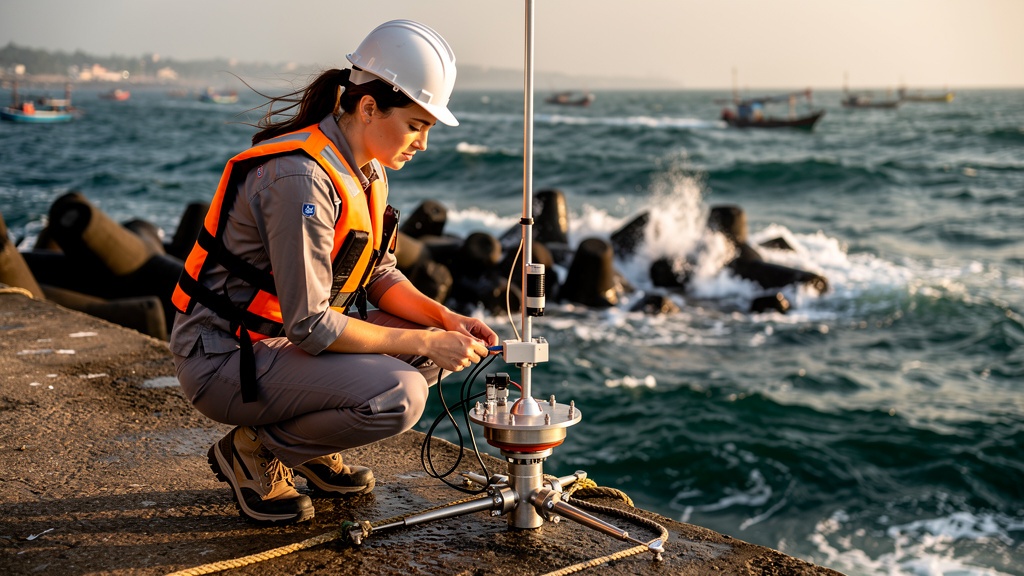
A marine engineer on the breakwater of Vizhinjam harbour on India's southern coast with a small spinning ocean research buoy.
Vizhinjam — where India’s wave-energy pilot history begins.
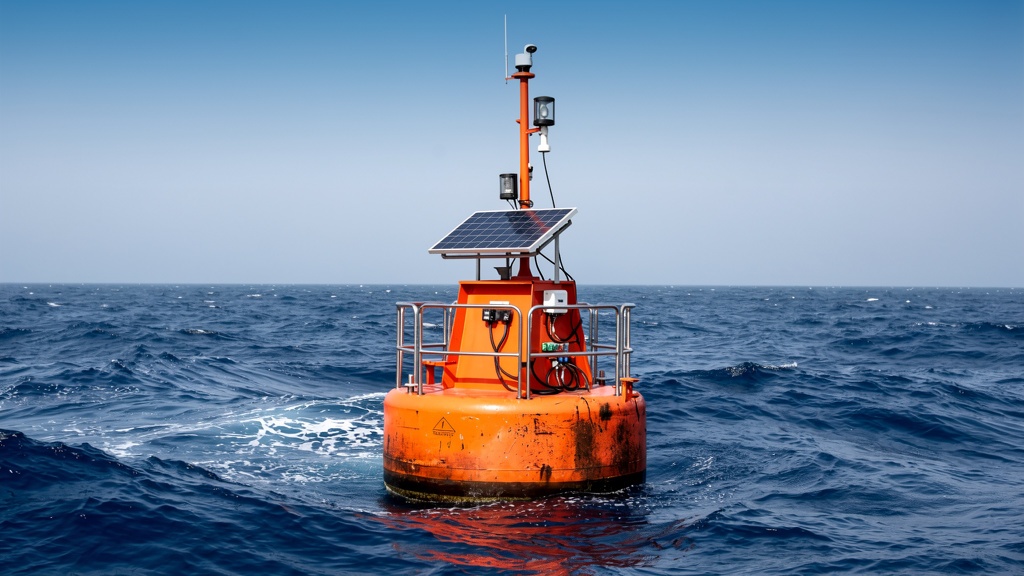
A wave-powered navigational buoy drifting on the open sea off India's coast, bright orange colour, calm to moderate waves.
Wave-powered navigational buoys — small in size but high in deployment count, and a useful survivability-data source.
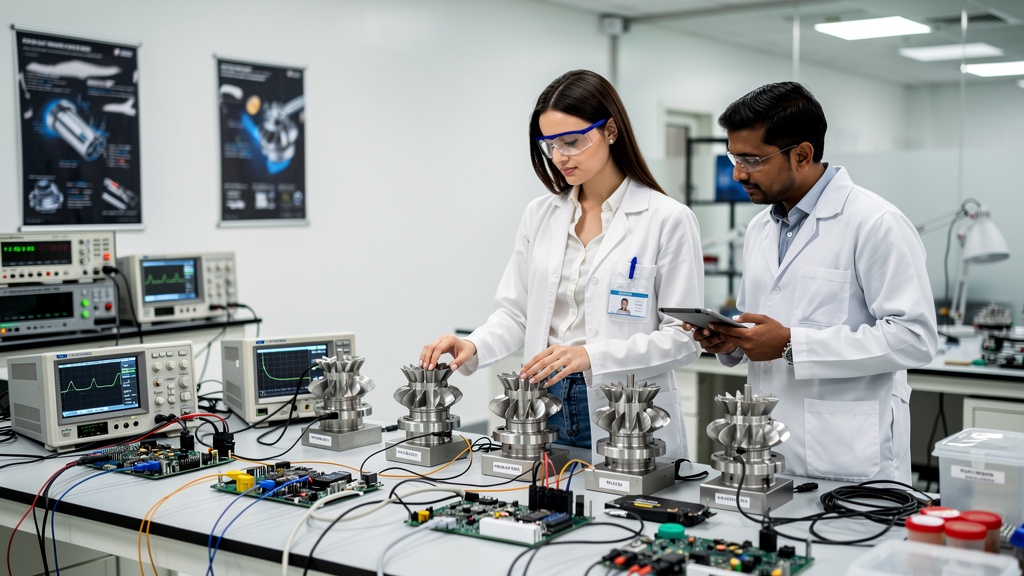
A lab technician testing small turbine prototypes on a long bench inside an Indian research laboratory.
Lab-bench work — most blue-energy R&D in India starts here.
Canonical Indian pilots and projects

An inventory of blue-energy activity in India

A technology-by-technology survey of what has been built, operated, piloted or studied in Indian waters or for Indian markets. Where dates are approximate, this list favours documenting the existence of the work over precise capacity. Where a project is now decommissioned, the entry makes that clear.

Operating & historical LTTD (desalination)

NIOT LTTD plants — operating list
PlantCapacitySinceNotes
Kavaratti LTTD~100,000 L/day fresh water; pump power ~100 kW class2005First NIOT LTTD plant; multi-year operating data informing design refinements.
Agatti LTTD~100,000 L/day2011–12Second plant; lessons shared with Kavaratti operating team.
Minicoy LTTDComparable capacity2012 onwardsThird island; SUVIDHA programme context.
SUVIDHA programme plantsMultiple small plants2010s onwardStrategic interventions under MoES’ island energy mandate.

Wave energy

Wave-energy pilot history in India
PilotCapacityEraNotes
Vizhinjam OWC pilot (NIOT)150 kW class1990sEarly grid-connected OWC at breakwater; low duty-cycle lessons led to design changes in subsequent pilots.
Wave-powered navigational buoys (NIOT)Sub-kW each2000s onwardsFleet deployment for Indian Coast Guard and port authorities; valuable survivability data.
Academic sea trials (IIT Madras, IIT Kharagpur, others)Lab & small sea-trial scale2010s onwardsContinue to inform anchor design, power take-off and structural survival topics.

Tidal energy (feasibility & design studies)

Tidal feasibility work in India (selected)
SiteForms studiedEraNotes
Gulf of KhambhatBarrage and stream1980s–2010sMultiple feasibility rounds; civil and ecological limits remain the active constraint.
Gulf of KutchBarrage and stream2010sStudies covering varied geometry; bay amplification smaller than Khambhat.
Sundarbans channelsStream and barrage feasibility2010sSocial and ecological constraints dominate; channel pilot concept remains on radar.
Palk Bay / Andaman channelsStream2020sPreliminary resource studies, less mature than Gujarat sites.

Floating PV (selected, India)

Selected Indian floating-PV projects
SiteCapacityEraNotes
Omkareshwar Dam Reservoir (Madhya Pradesh)~600 MW pipeline (utility scale)2018 onwardsAmong the world’s largest inland floating-PV projects.
Kayamkulam floating PV (Kerala)~500 kW pilot2018Early demonstration project.
Ramagundam floating PV (Telangana)~100 MW2020sReservoir-scale plant.
Rihand, Koyna, others — reservoir pilotsVarious2020sPipeline continues to extend.

Offshore wind lease blocks

Offshore wind lease blocks (India)
Lease blockCapacity indicationEraNotes
Gujarat — Pipavav & Jamnagar initial blocksTens of GW over multiple phases2024 onwardsFirst commercial lease awards; execution milestones defined.
Tamil Nadu — southern tip blocksMulti-phase pipeline2024 onwardsBuilds on Rameswaram–Kanyakumari resource profile.
Floating offshore wind pilotsSub-100 MW2020s pilotPre-commercial floating wind demonstrators.

Salinity-gradient & ocean-current projects

Most Indian work in these forms is at lab and academic pilot scale, primarily at IIT Kharagpur, IIT Madras, IISc Bengaluru, NIT Tiruchirappalli and a few other institutions. No commercial installations of PRO or RED in Indian waters as of 2024. Ocean-current energy work in India is also at resource-assessment and conceptual design stage.

Pipeline & roadmap

What is expected to be built in the next 5 years

A grounded reading of credible announced work — not a sales pitch.

  • 2025–26 — Initial commercial fixed-bottom offshore wind
    First fixed-bottom offshore wind projects off Gujarat enter construction. Foundation-engineering milestones. EPC contracts awarded.
  • 2025–27 — Additional LTTD plants at Lakshadweep & A&N
    Cumulative island plants across Lakshadweep and Andaman & Nicobar chains. SUVIDHA and successor programmes continue to scale sub-MW LTTD.
  • 2026–28 — Floating PV pipeline continued
    Inland pipeline extends; marine pilots in sheltered bays added. Storage sizing increasingly paired with new floating PV.
  • 2027–30 — Floating offshore wind pre-commercial
    First floating offshore wind demonstrators in deep-water cells; capacity-factor targets around 50% with joint storage.
  • Throughout — Lab → field pilots
    Salinity-gradient, current and OTEC pilots continue at lab scale; some reach small sea-trial deployments in selected concession cells.

Technology readiness levels across the family

The Indian project record across the seven blue-energy forms shows a clear TRL (Technology Readiness Level) hierarchy:

Approximate TRL snapshots (post-2024)
TechnologyApprox. TRL (India)Approx. TRL (global frontier)Comment
Offshore wind (fixed-bottom)8–99 (commercial, mult-GW)First-of-its-kind Indian project imminent; global commercial for two decades.
Floating offshore wind4–6 (pilot scale)7–8 (global pre-commercial)Indian supply chain being assembled.
Floating PV (reservoir)9 (commercial)9 (commercial)Indian capacity scales with deployment.
Floating PV (marine)5–7 (pilot)6–8 (global pilots)Marine-ambient corrosion needs more engineering.
LTTD (desalination)8 (operating)7–8 (global pre-commercial)India has the strongest at-sea track record.
OTEC (electricity)5–7 (pilot)6–7 (global pilot)LTTD is the de-facto Indian OTEC-LTTD deployment.
Wave energy5–7 (pilot)6–8 (global pilots)Vizhinjam hi/lo lessons; floating buoy deployments continue.
Tidal energy4–6 (feasibility)7–8 (commercial pilots globally)Indian feasibility has been extensive; civil & ecological limits.
Salinity-gradient (PRO, RED)3–5 (lab)5–7 (global pilots)Membrane lifetime is the lever.
Ocean current3–5 (resource)5–7 (global pilots)Cell-level co-location argument in India.

TRL is a rough ordinal indicator, not an absolute measure. The point of the table is that India is at or near the global frontier on LTTD, and within a few years of the global frontier on offshore wind; on the smaller forms, the work is at lab and pilot scale.

Lessons India has absorbed

A few cross-cutting lessons accumulate from the operating record:

  1. Survivability comes first. The Vizhinjam OWC lessons and bungy-anchor learnings across buoy programmes have shaped Indian engineering design conservatism for any device deployed at sea.
  2. Biofouling is not optional. Tropical biofouling imposes routine in-water cleaning cycles that materially affect operating cost.
  3. Operation is harder than engineering. Most pilot plants worldwide underperform in operations because the operational phase receives less engineering attention than deployment.
  4. Integration with grid or offtake — not the device itself — is the binding constraint at small industrial scale.
  5. Standards matter. India contributes to IEC TC 114 international ocean-energy standards work; participation helps procurement of internationally-financed equipment.

Where to read the canonical Indian record

  • NIOT annual reports and technical bulletins — a primary source for at-sea work.
  • MNRE status reports on offshore wind.
  • INCOIS atlas and regional studies.
  • MoES Deep Ocean Mission reports.
  • Peer-reviewed work in journals such as Renewable & Sustainable Energy Reviews, Energy for Sustainable Development, Journal of Ocean Engineering and Marine Energy.

The resources page collects direct links.

FAQ

Projects & technology questions

Has any Indian blue energy been deployed at commercial scale?
Offshore wind: pre-construction, with commercial lease blocks awarded in 2024. LTTD: at industrial-operating scale at three Lakshadweep islands. Floating PV: at commercial scale on inland reservoirs; marine pilots in sheltered bays. Wave, tidal, OTEC, salinity-gradient, ocean-current: at pilot or feasibility stage.
What is the most successful Indian pilot?
The LTTD plants at Kavaratti, Agatti and Minicoy are arguably the most successful — operational for nearly two decades, displacing diesel-powered RO desalination on energy-poor islands.
What happened to Vizhinjam?
The 150 kW OWC pilot operated at low duty-cycle in the 1990s and was decommissioned. The site, design and operating lessons informed subsequent Indian wave-energy device design.
What about the Deep Ocean Mission?
Deep Ocean Mission (MoES, 2021 onwards) includes technology components covering deep-sea mining, ocean biology, deep-water vessels and ocean-energy research. Several NIOT-anchored ocean-energy programmes are aligned with its work.